 MatsClocks
PowerPoint Presentation Clocks
⏰ Singapore Time Now
Singapore Time Now - Free PowerPoint Clock Download MatsClocks 3039
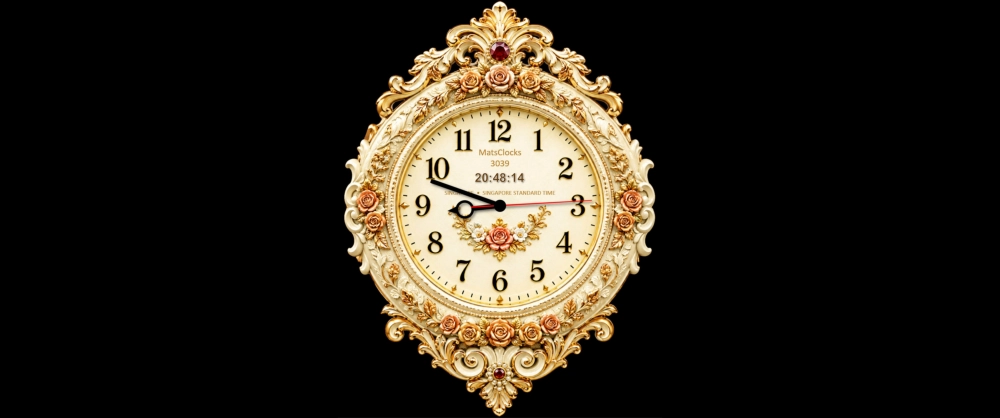
Free Download MatsClocks-3039 Singapore Time Now
MatsClocks 3039 Singapore Time now Clock can display live time on your PowerPoint Presentation Slide both in an analog clock format and a digital clock format next to it. Just download and run this PPTM Macro Enabled PowerPoint slide on your PC or Laptop. It will start showing live Singapore time now, with hours, minutes and seconds needles as well as a digital time next to it.
Note: All MatsClocks are in Zip files which can be opened using WinZip or any common file compression program. If you do not have PowerPoint software installed in your device then please get Microsoft_Office Software with essential Office software apps like Word, PowerPoint, Excel, and One Note etc. If you already have Microsoft Office installed then please update it today to get all the latest features.
Singapore Time: History, Timezone Singapore, Daylight Saving Time and Live Time Today
Time is something most people take for granted, until they need to coordinate a meeting with someone on the other side of the world. For travelers, international businesses, students, remote teams and online presenters, knowing the current Singapore Time can make the difference between being perfectly on schedule and being several hours late.
Singapore has a particularly interesting history when it comes to measuring time. The country has used several different time offsets over the past century, including a period when clocks were deliberately advanced as a form of daylight saving. Today, however, Singapore time follows a stable time system throughout the year.
For anyone searching for the timezone Singapore uses today, the answer is straightforward: Singapore operates on Singapore Time (SGT), UTC+8, throughout the year, with no current daylight saving clock changes.
What Is Singapore Time?
Singapore Time, commonly abbreviated as SGT, is the standard time used throughout Singapore.
Singapore currently operates at:
- Singapore Time (SGT)
- UTC+8 (Coordinated Universal Time)
- GMT+8 (Greenwich Meridian Time)
- IANA time zone: Asia/Singapore
- No current daylight saving time
There is only one official time zone in Singapore, so the same clock time applies throughout the country.
This makes Singapore time particularly convenient for international communication. Unlike countries such as the United States, Canada or Australia, where several time zones may need to be considered, a person arranging a meeting in Singapore does not need to determine which part of the country the participant is located in.
The timezone Singapore uses today has remained at UTC+8 since January 1, 1982.
The Fascinating History of Singapore Time
The history of Singapore Time is much more complicated than today's simple UTC+8 arrangement suggests.
Before standardized time zones became widely established, local time was often based on the position of the sun. Singapore's historical local time was approximately 6 hours, 55 minutes and 25 seconds ahead of Greenwich Mean Time.
That changed as transportation, commerce and communications expanded.
The introduction of standardized time was particularly important for railways and transportation. When different towns used slightly different local times, travelers and railway operators had to account for differences between locations. Standardized time made timetables and commercial activities much easier to coordinate.
1905: Standardized Time Arrives
On June 1, 1905, time throughout British Malaya was standardized to the mean time of the 105th meridian, corresponding to GMT+7.
This eliminated many of the small differences between local times in different towns and created a more practical common time system. (BiblioAsia)
But Singapore's relationship with GMT+7 would not last forever.
Singapore and Daylight Saving Time
One of the most interesting chapters in the history of Singapore Time was the country's experiment with daylight saving.
Singapore is close to the Equator, so its daylight hours do not vary dramatically across the year. Nevertheless, there were historical arguments for moving the clock forward so that people could have more daylight during the evening.
In 1933, clocks were advanced by 20 minutes, taking Singapore from GMT+7 to GMT+7:20. This was effectively a daylight-saving experiment. Singapore continued with this arrangement until 1936.
According to historical records, daylight saving in Singapore was observed for four years, from 1933 through 1936, and Singapore has not observed modern daylight saving time since then.
So, when people ask whether Singapore currently has daylight saving time, the answer is no.
Singapore Time During World War II
Singapore time keeping history took another dramatic turn during the Japanese Occupation.
In 1942, Singapore's clocks were changed to Japan Standard Time, putting Singapore at GMT+9. This was approximately one and a half hours ahead of the pre-war Singapore time.
The change was more than a technical adjustment. Time itself became connected to the political circumstances of the occupation.
After the Japanese Occupation ended in 1945, Singapore returned to GMT+7:30. This half-hour offset then remained in place for several decades.
Why Did Singapore Time Change to UTC+8?
The modern history of the timezone Singapore uses begins in 1982.
Before 1982, Timezone Singapore was operating at GMT+7:30. Malaysia was also operating with different time arrangements between Peninsular Malaysia and East Malaysia.
In 1981, Malaysia decided to synchronize its national time by moving Peninsular Malaysia forward by 30 minutes. Singapore decided to follow the change because of its close economic and geographic relationship with Malaysia and to reduce confusion for travelers and businesses. (National Archives of Singapore)
At midnight on January 1, 1982, Singapore advanced its clocks by 30 minutes.
The official Timezone Singapore or the Singapore Standard Time is now defined as eight hours ahead of Greenwich Mean Time.
That is the basis of the modern Singapore Time system.
Does Singapore Have Daylight Saving Time Today?
No. Singapore does not currently observe daylight saving time.
The country's clocks remain on timezone Singapore at UTC+8 throughout the year, meaning there is no annual spring clock change and no autumn clock change. Current 2026 time-zone data shows no clock change scheduled for Singapore.
This is an important advantage for international businesses.
Imagine a company in London scheduling a recurring video conference with colleagues in Singapore. If one country changed its clocks seasonally while the other did not, the meeting could move by an hour relative to the participants.
With Singapore remaining permanently on UTC+8, Singapore's side of the equation remains stable.
Of course, countries communicating with Singapore may still change their own clocks because of daylight saving rules. Therefore, international scheduling software and live clocks should account for the time zone of each location rather than simply assuming a fixed difference.
Modern Singapore Time and International Business
Singapore has become an important international center for finance, technology, logistics, aviation, shipping and commerce.
That makes accurate time particularly important.
A Singapore-based company might communicate with:
- Customers in Europe
- Suppliers in China
- Investors in the United States
- Partners in Australia
- Employees working remotely
- Regional offices throughout Southeast Asia
A simple timezone Singapore mistake can create unnecessary confusion.
For example, a presentation scheduled for 10:00 AM in Singapore needs to be correctly interpreted by someone joining from another country. The situation becomes even more complicated when the other country observes daylight saving time.
This is why a live Singapore Time display can be useful in offices, conference rooms, classrooms and presentations.
Singapore Time in the Digital Age
Modern life has changed the way people think about time.
A century ago, time was primarily represented by mechanical clocks, watches and railway timetables. Today, time is integrated into computers, smartphones, calendars, cloud applications, video conferencing platforms and international business systems.
The underlying principle remains the same: everyone needs a reliable reference.
Atomic clocks, computer networks and internet-based time synchronization have made extremely accurate timekeeping possible. At the same time, users often still want something very simple, a clock they can see immediately.
That is where a large visual clock can be useful.
How MatsClocks 3039 Helps Display Live Singapore Time
MatsClocks 3039 takes the idea of a traditional clock and brings it into a PowerPoint presentation.
A PowerPoint presentation normally focuses on information such as charts, photographs, diagrams and text. But a live clock can add another useful layer of information, particularly when the presentation involves international audiences.
A PowerPoint clock configured for Singapore can display live Singapore Time while the presentation is running.
This can be especially useful for:
International Business Presentations
A company presenting to customers or partners in Singapore can keep Singapore's local time visible on the screen.
This provides an immediate visual reference without requiring someone to open another application.
Online Meetings
For presentations involving participants across several countries, displaying the Singapore clock can help establish a shared understanding of the meeting's local time.
Education
Teachers and lecturers can use a live clock to demonstrate time zones, international geography and global communication.
Timezone Singapore can also serve as a useful example when explaining how UTC offsets work.
Travel Presentations
Travel companies, aviation professionals and tourism presenters can display Singapore Time while discussing itineraries, flights or international schedules.
Corporate Events
A large clock can also help presenters keep track of the timing of a session, particularly when the audience includes participants from Singapore or other Asian markets.
A Live Clock Is More Than Decoration
A clock on a PowerPoint slide might initially appear to be a visual feature, but it can have a practical purpose.
When an audience can see the current local time, the information becomes immediately understandable.
Instead of saying:
"The current Singapore time is eight hours ahead of UTC."
A presentation can simply display a clock showing the current local Singapore time.
This is particularly useful when presentations are running continuously on a screen.
For example, a corporate presentation displayed on a large monitor in an office could show information while simultaneously keeping Singapore Time visible.
Why a Singapore Time PowerPoint Clock Can Be Useful for Global Teams
Remote work has made international time zones part of everyday business.
A project team might include employees in Singapore, India, Australia, Europe and North America.
Every participant is working according to a different local clock.
A dedicated Singapore clock can make one location's working hours immediately visible.
For businesses dealing regularly with Singapore-based customers or teams, this can help with:
- Meeting coordination
- Customer support
- International presentations
- Training sessions
- Project management
- Remote collaboration
- Travel planning
- Global sales operations
Because Singapore time does not currently change its clocks for daylight saving time, the Singapore reference itself remains stable throughout the year.
Singapore Time and the Future
The way people interact with time will continue to evolve.
Smartphones and computers already automatically convert time between locations. Artificial intelligence and increasingly sophisticated scheduling systems are making international coordination even easier.
Yet visual clocks remain valuable because they communicate information instantly.
A person does not need to interpret a calendar entry or open a time-zone application. A clearly displayed clock provides the information at a glance.
For businesses with international operations, that simplicity can be surprisingly useful.
Timezone Singapore is a stable UTC+8 arrangement that also makes it an interesting reference point for understanding modern global timekeeping.
Singapore Time: From Local Solar Time to a Global Business Clock
The story of Singapore Time is ultimately a story about how society has changed.
Singapore moved from locally calculated solar time to standardized regional time. It experimented with daylight saving. It experienced a dramatic wartime shift to Tokyo time. It returned to GMT+7:30 after World War II and eventually moved to UTC+8 in 1982.
Today, the system is considerably simpler.
Timezone Singapore Time is UTC+8 throughout the year, and Singapore does not currently observe daylight saving time.
For modern businesses, educators, travelers and presenters, however, knowing the time zone is only part of the challenge. The practical question is often: What is Singapore Time right now?
A live PowerPoint clock such as MatsClocks 3039 provides a convenient visual solution by bringing live Singapore time directly into a presentation environment.
Whether it is being used in a classroom, conference room, international business presentation or information display, a live Singapore clock can turn an abstract timezone concept into something immediately visible and useful.
Singapore Time may have changed many times throughout history, but today's UTC+8 system provides a simple and stable foundation for connecting Singapore with the rest of the world.
Free Download MatsClocks-3039 Singapore Time Now
If you do not have PowerPoint software installed in your device then
please get
Microsoft_Office Software with essential Office
software apps like Word, PowerPoint, Excel, and One Note etc. If you
already have Microsoft Office installed then please update it today to get
all the latest features.