 MatsClocks
PowerPoint Presentation Clocks
⏰ Australia Sydney Time Now
Display Live Australia Sydney Time Now in Your PowerPoint Presentation
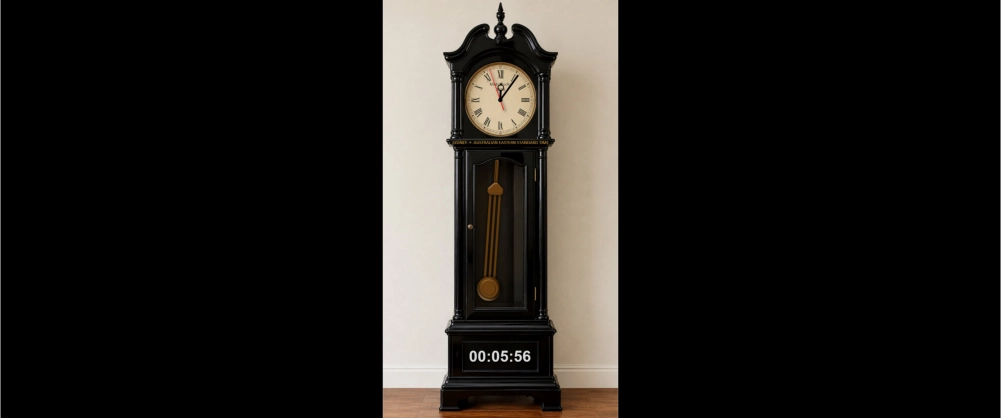
Free Download MatsClocks-3038 Australia Sydney Time Now!
MatsClocks 3038 Australia Sydney Time now Clock can display live Sydney Time now on your PowerPoint Presentation Slide in both analog clock and the digital time formats. Just download MatsClocks 3038 and run the PPTM Macro Enabled PowerPoint slide on your PC or Laptop. It will start showing live Sydney Time now in Australia with hours, minutes and seconds hands as well as a digital time display next to it. The clock starts showing Australia Sydney time now the moment you run the PowerPoint in Presentation mode and irrespective of the place you live in the world.
All MatsClocks are in Zip files which can be opened using WinZip or any common file compression program. Please get Microsoft_Office Software and update your PowerPoint.
Australia Sydney Time Now: A Complete Guide to Sydney Time, Australian Eastern Standard Time (AEST), Australian Eastern Dayllight Time (AEDT) and Its History
If you are searching for Australia Sydney time now, you are looking for more than simply the hour shown on a clock. Sydney's time zone is an important part of everyday life in Australia's largest city, influencing business hours, travel, school schedules, international meetings, sporting events, television broadcasts and communication with people around the world.
Sydney follows Australian Eastern Standard Time (AEST) during the standard-time part of the year, which is UTC+10. During daylight saving, Sydney moves one hour forward and uses Australian Eastern Daylight Time (AEDT), which is UTC+11. This seasonal change is one of the most important things to understand when checking Australia Sydney time now.
The time in Sydney can therefore be different from what someone might expect from the phrase "Australian Eastern Time." Australia is a huge country, and its states and territories do not all follow the same clock throughout the year.
Let's take a journey through Australia Sydney time now, Australian Eastern Standard Time, daylight saving, and the fascinating history behind the clock on Sydney's walls.
What Is Australia Sydney Time Now?
The simplest way to understand Australia Sydney time now is to begin with Sydney's time-zone location.
Sydney is in New South Wales, on Australia's southeastern coast. Its standard time zone is Australian Eastern Standard Time (AEST).
AEST = UTC+10
That means Sydney standard time is ten hours ahead of Coordinated Universal Time.
However, Sydney does not remain on Australian Eastern Standard Time (AEST) throughout the entire year. New South Wales observes daylight saving during the warmer months. During that period, clocks move forward by one hour and Sydney uses Australian Eastern Daylight Time (AEDT).
AEDT = UTC+11
Consequently, anyone checking Australia Sydney time now should always consider the date as well as the clock.
In 2026, New South Wales ended its daylight-saving period on 5 April, returning to standard time. The next daylight-saving change is scheduled for 4 October 2026, when clocks will move forward from 2:00 a.m. Australian Eastern Daylight Time (AEDT) to 3:00 a.m.
That seasonal adjustment is why simply remembering "Sydney is UTC+10" isn't always enough.
What Is Australian Eastern Standard Time?
Australian Eastern Standard Time, commonly abbreviated as AEST, is the standard time used across several parts of eastern Australia.
AEST is:
UTC +10 hours
It applies to places including New South Wales, Queensland, Victoria, Tasmania and the Australian Capital Territory during their standard-time periods.
Sydney, Melbourne, Canberra and Hobart therefore share the same standard-time offset.
But there is an important distinction.
Queensland stays on AEST Australian Eastern Standard Time throughout the year because it does not observe daylight saving. Sydney, on the other hand, changes to AEDT Australian Eastern Daylight Time during daylight-saving months.
This creates an interesting situation between Sydney and Brisbane. During the standard-time season, both have the same clock time. During daylight saving in New South Wales, Sydney becomes one hour ahead of Brisbane.
This is one reason that Australians themselves pay close attention to time-zone changes.
Australian Eastern Standard Time (AEST) vs Australian Eastern Daylight Time (AEDT): What Is the Difference?
The difference is easy to remember:
| Sydney Time | UTC Offset | When Used |
|---|---|---|
| AEST | UTC+10 | Standard time |
| AEDT | UTC+11 | Daylight saving |
When Sydney is on AEST, a clock showing 10:00 in Sydney corresponds to 00:00 UTC.
When Sydney is on AEDT, a clock showing 10:00 in Sydney corresponds to 23:00 UTC on the previous day.
For someone searching Australia Sydney time now, this distinction is particularly important when arranging international meetings.
A person in London, New York, Los Angeles, Delhi or Tokyo cannot always use the same Sydney time difference throughout the year because daylight-saving rules may change the relationship between the cities.
Why Does Sydney Change Its Clocks?
Daylight saving is designed to shift an hour of daylight from the early morning toward the evening.
In New South Wales, clocks normally move forward one hour in October and back one hour in April.
The NSW Government explains that daylight saving provides more daylight during the evening and can support outdoor activities after work and school.
For Sydney residents, the practical effect is easy to notice.
On the evening after daylight saving begins, the sun remains visible later according to the clock. On the other hand, the morning becomes darker because sunrise occurs later by the clock.
When daylight saving ends, the opposite occurs.
The clock moves backward one hour, giving people more daylight in the morning while reducing evening daylight.
Australia Sydney Time Now and Daylight Saving Time
The 2026 calendar provides a good example of how Sydney time changes.
New South Wales daylight saving ended on Sunday, 5 April 2026. At the daylight-saving transition, clocks moved back one hour.
Sydney consequently returned from:
AEDT (UTC+11)
to:
AEST (UTC+10)
Daylight saving is scheduled to return on Sunday, 4 October 2026. At 2:00 a.m. Australian Eastern Standard Time (AEST), clocks will move forward to 3:00 a.m.
Therefore, if you are checking Australia Sydney time now in September 2026, Sydney is in its standard-time period and is using Australian Eastern Standard Time AEST.
This is an excellent example of why a reliable world clock should automatically recognize the date and daylight-saving rules rather than relying on a fixed UTC offset.
The History Behind Australia Sydney Time Now
The story of Australia Sydney time now begins long before smartphones, computers and digital clocks.
In the nineteenth century, Australia did not originally have a single standardized time system.
Before standard time was introduced, individual towns and cities could effectively operate according to their own local mean time. The position of the sun determined local time, and different locations could therefore have slightly different times.
Imagine trying to coordinate a railway journey when every town's clock could differ.
As Australia's population, transportation networks and commercial connections developed, the need for standardized time became increasingly obvious.
Railways, shipping, telegraph communications and business all benefited from having a common time standard.
The Introduction of Standard Time in Australia
A major milestone came in 1895, when Australia's six colonies adopted Greenwich Mean Time as the basis for standard time.
This was an important step toward the modern Australian time-zone system.
Standardized time made it much easier to coordinate activities across increasingly connected communities.
Sydney could now operate according to a recognized standard rather than relying solely on local solar time.
The system continued to develop as Australia moved toward federation and eventually established the time-zone arrangements that are familiar today.
The modern concept of Australian Eastern Standard Time (AEST) is therefore part of a much longer story involving astronomy, transportation, government administration and the growth of modern communications.
The Early History of Daylight Saving in Sydney
The history of daylight saving in New South Wales is particularly interesting.
Australia experimented with daylight saving during the First World War. According to the NSW Government, daylight saving operated nationally from 1 January 1917 to 25 March 1917. It was also introduced during the Second World War for three summers beginning in 1942.
The idea was not immediately accepted as a permanent part of Australian life.
There were proposals and debates in New South Wales during the early twentieth century. NSW Parliament records note that daylight-saving bills were introduced in 1909 and 1911 but did not become law. Another attempt was made in 1916.
These debates reflected a fundamental question:
Should society adjust the clock to make greater use of available daylight?
It was a question that would continue to appear in Australian public debate for decades.
Daylight Saving Returns to New South Wales
Daylight saving was introduced again in New South Wales on 31 October 1971, following the passage of the Standard Time Act 1971.
The experiment eventually led to a significant public vote.
In 1976, NSW voters were asked whether daylight saving should be adopted permanently. The referendum recorded 1,882,770 votes in favour, compared with 868,900 against, with 35,507 informal votes.
Following the referendum, daylight saving continued in New South Wales.
Today, its rules are established under NSW legislation, including provisions governing summer time.
So when you look at Australia Sydney time now, you are actually seeing the result of more than a century of technological development, legislation and public debate.
When Does Sydney Daylight Saving Start and End?
For New South Wales, the general pattern is straightforward.
Daylight saving starts
The clocks move forward at 2:00 a.m. Australian Eastern Standard Time AEST on the first Sunday in October.
The clock becomes:
3:00 a.m. AEDT
Daylight saving ends
The clocks move backward at 3:00 a.m. AEDT on the first Sunday in April.
The clock becomes:
2:00 a.m. AEST Australian Eastern Standard Time
The NSW Government currently lists these seasonal rules and the 2026 and 2027 transition dates.
This means that anyone monitoring Australia Sydney time now should make sure their clock, calendar or world-time application handles daylight saving automatically.
Does All of Australia Use Sydney Time?
No.
This is one of the most important points about Australian time.
Australia has three principal standard time zones:
- Australian Eastern Standard Time — AEST — UTC+10
- Australian Central Standard Time — ACST — UTC+9:30
- Australian Western Standard Time — AWST — UTC+8
During daylight-saving months, some states move their clocks forward, creating additional effective time zones.
New South Wales, Victoria, Tasmania, the Australian Capital Territory and South Australia observe daylight saving.
Queensland, Western Australia and the Northern Territory do not.
This means Australia can have five different clock times during the summer daylight-saving period.
That may seem surprising to someone outside Australia.
Sydney Time and International Business
Understanding Australia Sydney time now is particularly useful for international business.
Sydney is a major financial, commercial and technology center, and many organizations work with companies and customers across Asia, Europe and North America.
A meeting scheduled for 9:00 a.m. Sydney time could occur during the previous calendar day for someone in North America.
Likewise, a Sydney employee attending a European meeting may find that the meeting takes place in the evening.
The situation becomes more complicated around daylight-saving transitions because other countries may change their clocks on completely different dates—or may not use daylight saving at all.
For international meetings, it is therefore safer to specify:
Sydney local time + date
rather than relying only on a time-zone abbreviation.
Australia Sydney Time Now for Travelers
Travelers also need to understand Sydney's clock.
When flying into Sydney from another country, your phone will usually update automatically if it has the correct location and time-zone settings.
However, traditional watches, wall clocks and some manually configured devices may need to be adjusted.
The difference can be especially noticeable after a long international flight.
Sydney's time may be several hours ahead of your home country, and daylight saving can add another hour depending on the season.
For travelers, checking Australia Sydney time now before making reservations, arranging airport transfers or contacting friends is a simple way to avoid confusion.
Sydney Time and Everyday Life
Time zones may sound like technical subjects, but they affect everyday life.
The Sydney workday, school day, public transport schedules, sporting events, television programs and social activities all depend on the local clock.
When daylight saving begins, people gain an additional hour of evening daylight according to the clock.
That can change how people experience summer evenings.
A walk along Sydney Harbour, an outdoor dinner, an evening sporting activity or simply spending time outside after work can all benefit from longer daylight hours.
The clock does not actually create additional sunlight, of course. Instead, daylight saving changes how that daylight aligns with the hours shown on the clock.
Why "Australia Sydney Time Now" Is a Useful Search
The phrase Australia Sydney time now is useful because it focuses on the actual local time in Sydney at the moment someone needs it.
A fixed statement such as "Sydney is UTC+10" does not always tell the complete story.
A current-time service should ideally account for:
- Sydney's geographic location
- The current date
- AEST Australian Eastern Standard Time
- AEDT Australian Eastern Daylight Time
- Daylight-saving transition dates
- UTC offset
- International date differences
That is especially important for people communicating across countries.
If someone simply remembers that Sydney is "10 hours ahead of UTC," they could be wrong during Sydney's daylight-saving season.
Sydney Time, Technology and the Modern World
There was a time when knowing Sydney's time meant consulting a clock, newspaper or telephone service.
Today, the answer is available almost instantly.
Smartphones, computers, smartwatches and online world clocks can automatically determine Sydney's current time.
Modern operating systems generally use time-zone databases that contain the rules needed to determine whether Sydney is observing Australian Eastern Standard Time AEST or Australian Eastern Daylight Time AEDT.
This is particularly valuable because daylight-saving dates are not simply a matter of adding one hour permanently.
The system must know when the seasonal transition occurs.
For people building digital clocks, websites or PowerPoint clocks, using a proper time-zone identifier such as Australia/Sydney is therefore more reliable than simply adding ten or eleven hours to UTC.
AEST Australian Eastern Standard Time and Sydney Time: A Simple Way to Remember It
If you want a quick mental model for Australia Sydney time now, remember these two numbers:
AEST = UTC+10
AEDT = UTC+11
Then remember the seasonal pattern:
Standard time → AEST
Daylight saving → AEDT
And for New South Wales:
October → clocks forward
April → clocks backward
That simple framework will answer most basic Sydney time-zone questions.
Frequently Asked Questions About Australia Sydney Time Now
What time zone is Sydney in?
Sydney is in the Australian Eastern time zone. During standard time it uses Australian Eastern Standard Time (AEST), UTC+10. During daylight saving it uses Australian Eastern Daylight Time (AEDT), UTC+11.
Is Sydney always UTC+10?
No. Sydney is UTC+10 during standard time. During daylight saving, Sydney moves to UTC+11.
Does Sydney have daylight saving?
Yes. New South Wales observes daylight saving. The clocks generally move forward on the first Sunday in October and backward on the first Sunday in April.
Does all of Australia use AEST Australian Eastern Standard Time?
No. Australia has three principal standard time zones, and daylight saving is not observed in every state or territory.
When does Sydney change from Australian Eastern Standard Time AEST to Australian Eastern Daylight Time AEDT?
Under the current NSW rules, daylight saving begins on the first Sunday in October. In 2026, that date is 4 October.
When does Sydney Return to Australian Eastern Standard Time AEST?
Daylight saving ends on the first Sunday in April. In 2026, Sydney returned to AEST on 5 April.
The Continuing Story of Australia Sydney Time Now
The story of Australia Sydney time now is really a story about how Australia learned to coordinate a vast country.
It began with local solar time, when different communities could follow their own clocks. It moved toward standardized time in the late nineteenth century as railways, communications and commerce made synchronization increasingly important.
Then came wartime experiments with daylight saving, decades of discussion, the return of daylight saving in New South Wales in 1971, and the 1976 referendum that helped establish the system Sydney uses today.
Today, the system feels almost invisible.
We glance at a smartphone and know the time. We schedule a video meeting with someone thousands of kilometers away. An airline ticket automatically displays departure and arrival times. A digital clock changes its offset without us touching a button.
Yet behind that simple number on the screen is a remarkable history of astronomy, transportation, legislation, technology and changing lifestyles.
Final Thoughts
Knowing Australia Sydney time now is about more than knowing what the hands of a clock are pointing toward.
Sydney operates on AEST (UTC+10) during standard time and AEDT (UTC+11) during daylight saving. New South Wales changes its clocks seasonally, generally moving forward in October and back in April.
The history of Sydney time stretches back to Australia's move from local mean time toward standardized time in the nineteenth century and includes wartime daylight-saving experiments, legislation and the 1976 NSW referendum.
Today, Sydney's clock connects one of the world's great cities with the rest of the globe.
Whether you are planning an international business call, watching an Australian sporting event, traveling to Sydney, communicating with family, or simply wondering what time it is on the other side of the world, understanding Australia Sydney time now makes the answer much clearer.
And the next time you look at a Sydney clock, remember that its hands represent far more than hours and minutes. They are part of a fascinating history of how Australia—and the modern world—learned to keep time together.
Free Download MatsClocks-3038 Australia Sydney Time Now!
If you do not have PowerPoint software installed in your device then
please get
Microsoft_Office Software with essential Office
software apps like Word, PowerPoint, Excel, and One Note etc. If you
already have Microsoft Office installed then please update it today to get
all the latest features. Now
Download MatsClocks 3038 and run the PowerPoint
Presentation to see the Live Australia Sydney Time Now, irrespective of
where you live on earth.