 MatsClocks
PowerPoint Presentation Clocks
MatsClocks GMT 5001
Coordinated Universal Time UTC PowerPoint PPTM Live Clock Timer
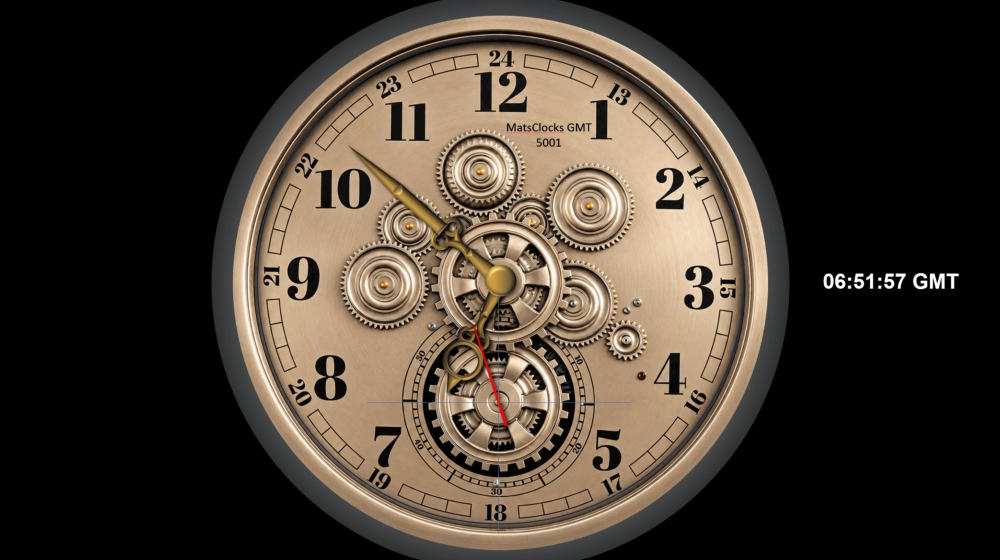
Free Download MatsClocks-GMT-5001
MatsClocks GMT 5001 Analog Timer Clock can display UTC time (Coordinated Universal time) on your PowerPoint Presentation Slide in both analog clock and the digital time formats. Download and run this PPTM or Macro Enabled PowerPoint slide on your PC or Laptop. Run the slide in presentation mode and move your mouse curser up and down on the slide. The GMT Clock will start showing live UTC time with hours, minutes and seconds needles as well as a digital time next to it. This is not local time, but UTC time or Coordinated Universal Time. It is your local time plus or minus your time zone factor. It is also called GMT or Greenwich Meridian Time.
All MatsClocks are in Zip files which can be opened using WinZip or any common file compression program. If you do not have PowerPoint software installed in your device then please get Microsoft_Office Software with essential Office software apps like Word, PowerPoint, Excel, and One Note etc. If you already have Microsoft Office installed then please update it today to get all the latest features.
UTC: The Invisible Clock That Keeps the Modern World in Step
Imagine that it is 10:00 in London.
At exactly that moment, it is 11:00 in Paris, 12:00 in Moscow, 2:30 in New Delhi, 6:00 in Tokyo and 2:00 in New York.
Millions of people are beginning their working day, sleeping, travelling, trading, communicating and operating machines according to different local clocks. Yet behind all those clocks is one common reference, a single global time scale that allows the world to agree on what "now" actually means.
That time scale is UTC: Coordinated Universal Time.
You may never have consciously used UTC. Your wristwatch may simply show local time. Your smartphone may say 4:30 PM. Your television may display a familiar local time. But beneath these everyday displays, computers, satellites, telecommunications networks, scientific laboratories, aircraft, ships, financial systems and countless other technologies rely on internationally coordinated time.
UTC: Coordinated Universal Time is, in many ways, the invisible clock of civilization.
It is the world's principal reference time scale for international timekeeping and forms the basis of civil time in most countries. The Bureau International des Poids et Mesures (BIPM) produces UTC using measurements from atomic clocks around the world.
But UTC has an extraordinary story behind it, the one involving the rotation of Earth, ancient astronomy, mechanical clocks, radio, atomic physics, satellites and the extraordinary realization that the Earth itself is not a perfectly reliable clock.
What Exactly Is UTC: Coordinated Universal Time?
The name sounds complicated: Coordinated Universal Time.
But the idea is surprisingly simple.
UTC provides a common reference against which the world's clocks and time zones can be compared.
If someone in India says an event occurred at 12:00 noon and someone in New York says the same event occurred at 2:30 AM, there needs to be a universally understood reference that tells computers and people that these are actually the same moment.
UTC: Coordinated Universal Time provides that reference.
Local time is then obtained by applying the appropriate time-zone offset to UTC.
For example, India uses Indian Standard Time (IST), which is UTC+5:30. Therefore, when UTC is 06:30, the local time in India is 12:00 noon.
The important point is that UTC itself does not change from country to country.
There is one UTC.
There are many local times.
This distinction becomes extremely important when computers communicate across international borders.
Why Didn't the World Simply Use Solar Time?
To understand UTC: Coordinated Universal Time, we have to go back to an era when there were no computers, satellites or atomic clocks.
For thousands of years, humans naturally measured time by watching the sky.
The Sun rose.
The Sun crossed the sky.
The Sun set.
The Earth rotated, and people used that rotation as their most obvious clock.
For a very long time, this was perfectly sensible.
But there was a problem.
The Earth is not a perfect clock.
Its rotation is irregular. It speeds up and slows down by small amounts because of interactions within the Earth, the Moon, the atmosphere, oceans and other physical effects.
Those variations are tiny from a human perspective.
But modern technology can measure them.
And once humans began building extraordinarily accurate clocks, something surprising became obvious:
The Earth does not keep time as consistently as an atomic clock does.
The traditional astronomical time scale eventually evolved into Universal Time, particularly UT1, which is based on the Earth's rotation. UT1 remains important because it tells us about the actual rotational orientation of Earth.
Greenwich and the Birth of Global Time
Before UTC, another name dominated international timekeeping: Greenwich Mean Time, or GMT.
Greenwich, in London, became associated with the Prime Meridian, the reference line from which longitude is measured.
For sailors, astronomers and mapmakers, knowing the time at Greenwich was enormously useful.
If a navigator knew the local solar time and also knew the time at Greenwich, the difference could help determine longitude.
The development of accurate marine chronometers made this practical.
Eventually, as railways, telegraphs and international communications expanded, societies needed something more than local solar time.
A train could leave one town according to one local clock and arrive somewhere hundreds of kilometres away where the local solar time was slightly different.
The industrial world needed synchronization.
The expansion of telecommunications made the problem even more obvious.
The world was becoming connected, and connected systems needed a common time reference.
The Arrival of the Atomic Clock
The real revolution came from an unexpected source: the atom.
Scientists discovered that atoms provide extraordinarily stable natural frequencies.
Instead of asking:
"Where is the Sun?"
or
"How long did the Earth take to rotate?"
scientists could ask:
"How many oscillations of a particular atomic transition have occurred?"
That turned out to be an extraordinarily reliable way of defining time.
In 1967, the international scientific community redefined the SI second using the frequency of the ground-state hyperfine transition of the caesium-133 atom. The modern definition remains based on a fixed numerical value for that frequency.
This was a monumental change.
For thousands of years, the Earth had effectively been humanity's clock.
Now the atom became the basis of the most precise measurement of time.
The Road to UTC: Coordinated Universal Time
The transition from astronomical time to atomic time did not happen overnight.
Atomic timekeeping began developing rapidly during the 1950s. International Atomic Time, known as TAI, emerged as a continuous atomic time scale.
But scientists and navigators faced a dilemma.
Atomic clocks were wonderfully stable.
Earth's rotation was astronomically meaningful.
So which one should the world's official time follow?
The answer was: both, as far as possible.
UTC: Coordinated Universal Time was developed as a compromise between atomic precision and astronomical reality.
Early versions of coordinated atomic time used small frequency adjustments and fractional steps to keep atomic time close to Earth's rotational time. The system was formalized during the 1960s. In 1967, the name "Coordinated Universal Time" was adopted internationally.
Then came the decisive change.
1972: The Modern UTC: Coordinated Universal Time is Born
In 1972, the modern system of UTC: Coordinated Universal Time was introduced.
The principle was elegant.
The second would be based on atomic time.
But UTC would be kept close to Earth's rotational time by occasionally inserting a one-second adjustment.
This adjustment became known as a leap second.
The goal was to keep UTC within approximately 0.9 seconds of UT1, the astronomical time scale derived from Earth's rotation.
Think of it this way.
Imagine two clocks:
One is an extremely precise atomic clock.
The other is Earth.
The atomic clock ticks at an extraordinarily stable rate.
Earth, however, occasionally rotates a little faster or slower.
UTC essentially says:
"Let us use the atomic clock for precision, but occasionally make a tiny adjustment so that our civil time does not drift too far away from Earth's rotation."
That ingenious compromise has served humanity for decades.
What Is a Leap Second?
Most people have heard of a leap year.
Far fewer have heard of a leap second.
A leap year adds a day to the calendar because the Earth's orbital period does not fit perfectly into 365 days.
A leap second is much smaller.
It adds, or under the historical system could theoretically remove, one second from UTC to keep it close to Earth's rotational time.
For example, an ordinary final minute might progress:
23:59:57
23:59:58
23:59:59
00:00:00
During a positive leap second, it can instead contain:
23:59:57
23:59:58
23:59:59
23:59:60
00:00:00
That extra second is not an error.
It is an intentional adjustment.
Since 1972, leap seconds have been introduced when necessary based on observations and predictions of Earth's rotation.
Who Creates UTC?
There isn't a giant clock sitting in one room somewhere saying:
"This is UTC."
The reality is far more fascinating.
The Bureau International des Poids et Mesures (BIPM) in France produces the international UTC time scale.
National laboratories and observatories around the world maintain their own extremely accurate realizations of UTC, known as UTC(k).
These laboratories operate sophisticated atomic clocks and contribute their measurements to the international system.
The BIPM combines clock data from laboratories around the world to calculate UTC.
So UTC is effectively a global collaboration.
No single country owns it.
No single laboratory independently determines it.
It is produced from an enormous international network of precision clocks.
UTC and TAI: What Is the Difference?
Another name that often appears alongside UTC: Coordinated Universal Time is TAI—International Atomic Time.
The difference is important.
TAI is a continuous atomic time scale.
It does not insert leap seconds.
UTC is based on TAI but includes the historical leap-second mechanism that has been used to keep UTC close to Earth's rotation.
In simple terms:
TAI is the extremely steady atomic clock.
UT1 represents Earth's rotation.
UTC is the international compromise between the two.
The relationship between these time scales is fundamental to modern precision timekeeping.
Why Is UTC: Coordinated Universal Time So Important?
You might wonder:
"Why does the world need time to be synchronized so precisely?"
The answer becomes obvious when you look at modern civilization.
Imagine the Internet without synchronized clocks.
Imagine financial systems without reliable timestamps.
Imagine aircraft navigating across oceans using unsynchronized systems.
Imagine satellites whose clocks were drifting apart.
Imagine telecommunications networks operating with different interpretations of time.
Modern technology depends on knowing not merely what happened, but exactly when it happened.
UTC provides the common temporal reference that allows these systems to work together.
UTC and Aviation
Aviation is one of the most important users of universal time.
An aircraft may take off from India, cross several time zones, fly over oceans and land in Europe.
During that journey, local clocks may change repeatedly.
But the aircraft does not need to think in terms of dozens of local clocks.
International aviation operations can use UTC as a common reference.
Flight plans, weather observations, navigation information, communications and operational records can all be coordinated using a common time standard.
This prevents a simple but potentially dangerous problem:
Which local time are we talking about?
UTC: Coordinated Universal Time answers the question.
UTC and Maritime Navigation
Ships face an even more dramatic version of the same problem.
A vessel may spend weeks crossing oceans.
During the voyage, it can pass through multiple time zones.
Historically, accurate time was crucial for determining longitude.
Today, navigation systems have become vastly more sophisticated, particularly through satellite navigation.
Yet precise time remains fundamental.
Modern navigation systems do not simply need coordinates.
They need accurate measurements of when signals were transmitted and received.
That is where time becomes distance.
UTC and GPS
Here is one of the most remarkable facts about modern technology:
Satellite navigation is fundamentally a time-measurement system.
Your smartphone does not merely ask satellites:
"Where are you?"
It effectively measures the travel time of radio signals from satellites.
Because radio signals travel at approximately the speed of light, even a tiny error in time can create a significant error in calculated distance.
GPS and other Global Navigation Satellite Systems therefore depend on extraordinarily precise clocks.
GNSS technology has also transformed how UTC: Coordinated Universal Time and Earth's rotation are monitored and compared. Modern systems can measure the relationship between time and Earth's orientation with extraordinary precision.
So when your phone tells you where you are, atomic time is quietly involved.
UTC and the Internet
The Internet is perhaps the clearest example of why global time matters.
Servers around the world need to agree about events.
Suppose you log into a website at 10:00:01 UTC: Coordinated Universal Time.
Another server records an event at 10:00:02 UTC.
A security system records another event at 10:00:03 UTC.
These timestamps can help establish the order in which things happened.
Computers commonly synchronize their clocks using network time protocols and time servers.
The result is that computers thousands of kilometers apart can maintain remarkably close agreement.
NIST, for example, distributes time from its national time scale through radio services and the Internet, allowing computers to adjust their clocks.
UTC and Cybersecurity
Time is also an important part of cybersecurity.
Security logs need timestamps.
Authentication systems need timestamps.
Digital certificates have validity periods.
Security investigations often reconstruct an incident by examining events recorded on different computers.
Imagine a cyber attack involving:
- a user's laptop,
- a web server,
- a database,
- a cloud server,
- a firewall,
- an email server and
- a security monitoring system.
If every machine has a different clock, reconstructing the attack can become extremely difficult.
Synchronized timestamps allow investigators to build a chronological picture of what happened.
In cyber security, knowing when something happened can be almost as important as knowing what happened.
UTC and Banking
Financial markets operate at astonishing speed.
Money can move across borders in fractions of a second.
Transactions need timestamps.
Trading systems need synchronized clocks.
Electronic records need to establish the order of events.
A transaction initiated in one country may be processed by systems in several other countries.
Using a common time reference makes it possible to compare events consistently.
UTC: Coordinated Universal Time therefore contributes indirectly to the enormous international financial system that operates every day.
UTC and Telecommunications
Modern telecommunications networks also depend heavily on precise timing.
Mobile networks, optical networks, data centers and other communication infrastructure use synchronized clocks for a variety of technical purposes.
In high-speed networks, synchronization is not merely convenient.
It can be essential.
Different components must coordinate transmissions, scheduling, measurements and other operations.
As telecommunications have become faster and more complex, precise time has become increasingly valuable.
UTC and Data Centres
Walk into a modern data centre and you may see thousands of servers working together.
They are performing millions of operations.
Some systems may be located in one building.
Others may be distributed across several cities or countries.
Their clocks need to remain synchronized.
If one server thinks it is 14:00:05 while another thinks it is 13:59:58, software can encounter problems ranging from confusing logs to incorrect event ordering.
UTC: Coordinated Universal Time provides the global reference behind many of these synchronization systems.
UTC and Scientific Research
Scientists cannot afford sloppy timekeeping.
Astronomers observe events occurring billions of kilometers away.
Particle physicists measure incredibly short intervals.
Geophysicists monitor Earth's movements.
Researchers compare measurements from instruments located in different countries.
Scientists studying earthquakes, radio signals, satellites and astronomical phenomena often need highly accurate timestamps.
When several instruments observe the same event, researchers must know precisely when each measurement occurred.
UTC: Coordinated Universal Time and related atomic time scales provide the framework for making those comparisons.
UTC and Space Exploration
Spacecraft operate in an environment where timing can become extraordinarily complicated.
A command sent from Earth takes time to reach a spacecraft.
A signal returned from the spacecraft also takes time.
Navigation calculations require extremely accurate timing.
Satellites carry precise clocks.
Ground stations need synchronized clocks.
Mission control systems need to know when commands were transmitted, received and executed.
A tiny timing error can become significant when dealing with enormous distances.
Space exploration therefore represents one of the ultimate demonstrations of the importance of precise time.
UTC and Weather Forecasting
Weather satellites continuously observe Earth's atmosphere.
Radar systems, satellites, weather stations, aircraft and ocean buoys all produce measurements.
These measurements need accurate timestamps.
A weather model is not simply a collection of numbers.
It is a moving picture of the atmosphere.
Temperature, pressure, humidity, wind and other measurements must be associated with the correct moment.
Precise time allows scientists to combine observations from thousands of locations into a coherent picture of the changing atmosphere.
UTC and Earthquake Monitoring
Earthquakes happen quickly.
Seismometers located hundreds or thousands of kilometres apart detect waves travelling through the Earth.
To determine where an earthquake occurred, scientists compare when different stations detected the seismic waves.
That means time becomes a measuring instrument.
If the clocks at different stations are not accurately synchronized, the calculated location can be wrong.
Again, time is doing much more than telling us whether it is morning or evening.
UTC: Coordinated Universal Time is helping us measure the physical world.
UTC in Everyday Life
You may think that UTC belongs only to scientists and engineers.
It doesn't.
You encounter its consequences every day.
When you:
- send an international email,
- make an online payment,
- use GPS navigation,
- book an airline ticket,
- connect to a cloud service,
- watch an international live event,
- access a website hosted overseas,
- use a smartphone,
- synchronize photographs,
- make an international telephone call,
- use online banking,
- communicate through social media,
There is a good chance that UTC or a system synchronized to UTC: Coordinated Universal Time is somewhere behind the scenes.
You see your local time.
Your devices often work with a much more universal concept of time underneath.
UTC Is Not the Same as a Time Zone
This is an important distinction.
UTC is a reference time scale.
A time zone is a geographical convention for displaying local time.
For example:
India uses UTC+5:30.
Japan uses UTC+9.
UTC: Coordinated Universal Time itself does not become "Indian UTC" or "Japanese UTC."
Instead, local clocks are calculated from UTC according to the rules of the relevant time zone.
This is why international software often stores timestamps in UTC and converts them into local time only when displaying them to a person.
Why Computers Love UTC
Humans are comfortable saying:
"I'll meet you at 5 PM."
Computers prefer something much more precise.
A computer can store a timestamp such as:
2026-08-28 11:30:00 UTC: Coordinated Universal Time
That timestamp has an unambiguous global meaning.
It does not matter whether the person reading it is in India, Britain, Japan or Brazil.
The same instant is being described.
This is one reason UTC: Coordinated Universal Time is so useful in software engineering, databases, cloud computing and distributed systems.
The computer can store the universal time and then display the appropriate local time to the user.
The Problem of Daylight Saving Time
UTC becomes even more valuable when daylight-saving rules are involved.
Some countries change their clocks during part of the year.
When that happens, local time can shift.
UTC: Coordinated Universal Time does not perform these seasonal changes.
This makes UTC an excellent stable reference for systems that must operate internationally.
A company with employees in ten countries may have ten different local-time situations.
But its servers can continue working from a common UTC reference.
Why Is UTC Written With a "Z"?
You may have seen timestamps ending with the letter Z.
For example:
2026-08-28T12:00:00Z
The "Z" means Zulu time, which is the aviation and military designation commonly used for UTC.
So:
12:00 UTC
and
12:00Z
refer to the same UTC: Coordinated Universal Time.
This notation is especially common in aviation, military communications, computing, software development and international operations.
UTC: Coordinated Universal Time is a Global Agreement
One of the most remarkable things about UTC is that it is not simply a scientific invention.
It is also an international agreement.
Different nations have different cultures, governments, languages, geographical locations and local time conventions.
Yet scientists and engineers around the world need a common reference.
UTC provides exactly that.
The BIPM calculates UTC, while national laboratories maintain local realizations of it and contribute measurements to the international calculation.
It is a wonderful example of international cooperation that most people never notice.
The Future of UTC: Coordinated Universal Time
For decades, the leap second worked remarkably well.
But modern technology has changed the situation.
A one-second adjustment that is trivial to a human being can be surprisingly troublesome for computer systems that expect time to progress continuously.
Distributed computing systems, telecommunications networks, navigation systems and other highly automated technologies can have difficulty handling an unexpected extra second.
As technology became increasingly dependent on continuous digital time, scientists and engineers began reconsidering the leap-second system.
In 2022, the General Conference on Weights and Measures decided to change the treatment of the difference between UTC and Earth's rotational time, with the goal of allowing UTC to remain continuous enough for modern systems while preserving its role as the international reference. The change is intended to be implemented by or before 2035.
This does not mean that UTC: Coordinated Universal Time is disappearing.
Quite the opposite.
It means that humanity is trying to make UTC better suited to the technological world it now supports.
The Extraordinary Journey of a Second
There is something almost poetic about the history of UTC.
For thousands of years, humans looked upward and used the movement of the Sun to tell time.
Then came mechanical clocks.
Then pendulum clocks.
Then quartz clocks.
Then atomic clocks.
And finally, a worldwide network of laboratories began comparing some of the most precise clocks ever built.
A single second went from being an everyday approximation to becoming one of the most carefully defined quantities in science.
Today, a second is defined using the behavior of Cesium atoms.
That tiny interval is then used to construct minutes, hours, days and years, and ultimately the time systems upon which modern civilization depends.
UTC: The Invisible Infrastructure of Civilization
There are technologies we notice because they are spectacular.
We notice rockets.
We notice smartphones.
We notice aircraft.
We notice satellites.
We notice high-speed Internet.
But UTC: Coordinated Universal Time is different.
It is almost invisible.
Nobody wakes up in the morning and says:
"Thank goodness UTC is working today."
Yet if accurate global time synchronization suddenly disappeared, the consequences could be enormous.
Networks would become confused.
Financial systems could have difficulty ordering transactions.
Navigation would become less reliable.
Scientific measurements would be harder to compare.
Telecommunications networks would face synchronization problems.
Computer logs would become less trustworthy.
International operations would become more complicated.
Modern civilization would suddenly discover how much it depends on something as apparently simple as knowing the correct time.
UTC Is More Than a Clock
UTC: Coordinated Universal Time is often described as a time standard.
That is true, but it doesn't quite capture its importance.
UTC is a global coordination system.
It allows a computer in India to agree with a server in America.
It allows a satellite to coordinate with a ground station.
It allows scientists in different countries to compare measurements.
It allows aircraft crossing oceans to use a common temporal reference.
It allows financial systems operating across borders to establish a common sequence of events.
It allows the digital world to share one fundamental idea:
This is the same moment.
And that may be the most important thing about UTC: Coordinated Universal Time.
It does not tell humanity what time it is in every city.
Instead, it gives the world a common starting point from which every local time can be understood.
Conclusion: The Clock We Never See
Every morning, millions of clocks wake up with us.
The clock on the wall.
The clock on the smartphone.
The clock inside the car.
The clock on the computer.
The clocks inside satellites, aircraft, ships, telecommunications networks and data centres.
They may display different times because we live in different places.
But beneath that enormous variety is a common reference.
UTC: Coordinated Universal Time.
It is the product of centuries of human curiosity about time, decades of scientific progress in atomic physics, international cooperation and an ingenious attempt to reconcile the extraordinary stability of atoms with the imperfect rotation of our planet.
UTC reminds us of something profound.
Time feels simple because we experience it every second.
Measuring it accurately is anything but simple.
And somewhere, right now, thousands of clocks around the world are quietly comparing themselves, laboratories are calculating differences measured in tiny fractions of a second, satellites are carrying precision clocks through space, computers are synchronizing their internal clocks, and the BIPM is maintaining the international time scale that helps keep the world's technological civilization in step.
We rarely notice it.
We don't need to.
That is the beauty of UTC or Coordinated Universal Time.
The world's most important clock is the one most of us never see.
Free Download MatsClocks-GMT-5001
Show Live UTC Clock Timer to your audience in your PowerPoint Presentation.
If you do not have PowerPoint software installed in your device then please
get
Microsoft_Office Software with essential Office
software apps like Word, PowerPoint, Excel, and One Note etc. If you
already have Microsoft Office installed then please update it today to get
all the latest features.