 MatsClocks
PowerPoint Presentation Clocks
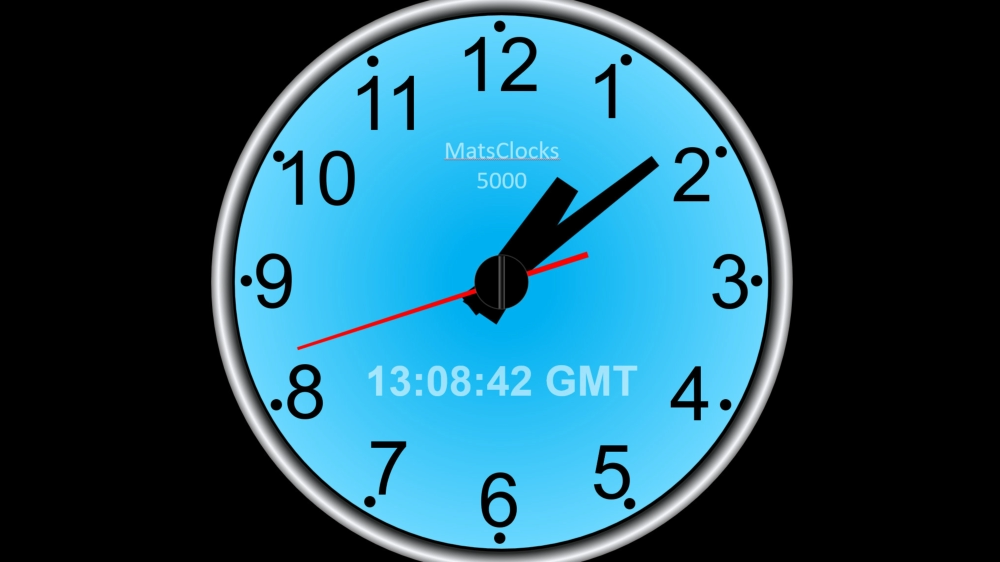
MatsClocks GMT 5000
Greenwich Meridian Time PowerPoint PPTM Live Clock Timer
Free Download MatsClocks-GMT-5000
MatsClocks GMT 5000 Time Clock can display GMT / UTC time on your PowerPoint Presentation Slide in both analog clock and the digital timer. Just download and run this PPTM Macro Enabled PowerPoint slide on your PC or Laptop. Run the slide in presentation mode and the GMT Clock will start showing live time with hours, minutes and seconds needles as well as a digital time next to it. This is not local time, but GMT time or Greenwich Meridian Time. It is your local time plus or minus your time zone factor.
All MatsClocks are in Zip files which can be
opened using
WinZip or any common file compression program. If
you do not have PowerPoint software installed in your device then please get
Microsoft_Office Software with essential Office
software apps like Word, PowerPoint, Excel, and One Note etc. If you
already have Microsoft Office installed then please update it today to get
all the latest features.
GMT (Greenwich Mean Time): The Story of the World’s Great Timekeeper
Time is something every human being experiences, yet measuring it accurately has been one of civilization’s greatest challenges. Today, we glance at a watch or smartphone and instantly know the exact hour, minute and second. But for centuries, knowing the correct time, and more importantly, agreeing on what the correct time should be, was surprisingly difficult.
One of the most important milestones in the history of timekeeping was the creation of Greenwich Mean Time, or GMT. For generations, GMT served as a reference point from which the world could establish its clocks, maps, navigation systems, railway timetables and international communications. GMT is normally always shown in 24 hour format. Even though modern science has replaced GMT as the world's primary scientific time standard with Coordinated Universal Time (UTC), GMT remains enormously important and is still widely used in everyday life.
Here is a True Story of how I ended up standing without clothes just 5 feet behind a 5 ton missile fired from my own war ship where I was posted, because I had a wrist watch that showed time in 12 hours and not in 24 hours format. I had no idea if it was day or night because inside a ship there is no way of knowing unless you go to the upper decks of the ship.
The World Before GMT
To understand why GMT became important, we first need to imagine the world before standardized time.
For much of history, people measured time according to the position of the Sun. When the Sun reached its highest point in the sky, it was approximately noon. But this created a problem: noon occurred at different moments in different places.
A person in London could have noon while someone hundreds of kilometers east or west experienced a different solar time. Before rapid transportation and instant communication, this caused relatively little difficulty. A town could simply set its clocks according to its own local solar time.
The situation changed dramatically during the Industrial Revolution.
Railways began connecting cities over enormous distances. Trains needed reliable timetables, and passengers needed to know exactly when trains would arrive and depart. Telegraph networks also allowed messages to travel almost instantaneously across great distances. Suddenly, having hundreds of different local times became inconvenient and potentially dangerous.
A universal reference time was becoming necessary.
Why Greenwich Meridian Time (GMT)?
The story of GMT is closely connected with the Royal Observatory at Greenwich, established in England in 1675 by King Charles II.
The observatory was created partly to solve a major problem facing maritime nations: determining longitude at sea.
Latitude could be determined relatively easily by observing the Sun or stars. Longitude was much more difficult. A ship could know how far north or south it was, yet determining how far east or west it had travelled was historically a major challenge.
Accurate time was the key.
If a navigator knew the local solar time aboard a ship and also knew the exact time at a fixed reference location, the difference between those two times could be converted into longitude. In simplified terms, the Earth rotates approximately 15 degrees of longitude every hour.
Greenwich therefore became deeply connected with astronomical timekeeping and navigation.
The Birth of Greenwich Mean Time (GMT)
The term Greenwich Mean Time or GMT refers to the mean solar time at Greenwich.
The word "mean" is important. The apparent movement of the Sun across the sky is not perfectly uniform throughout the year because Earth's orbit around the Sun is slightly elliptical and Earth's axis is tilted. Consequently, apparent solar time can vary slightly.
Astronomers therefore used mean solar time, based on an idealized uniform solar day.
By the nineteenth century, Greenwich Mean Time had become an increasingly important standard, particularly for navigation, astronomy and Britain’s expanding railway system.
British railways gradually adopted a common time based on Greenwich. By the middle of the nineteenth century, railway companies were increasingly using GMT rather than maintaining separate local times for different towns.
This was an enormous practical change.
A traveller could now look at a railway timetable and understand that a stated departure time represented the same standard across the railway network.
The International Meridian Conference
The importance of Greenwich Meridian Time (GMT)became global in 1884.
Representatives from 25 nations gathered in Washington, D.C., for the International Meridian Conference. Their task was to select a prime meridian, the line of zero degrees longitude from which longitude around the world would be measured.
Greenwich was selected as the prime meridian.
The Greenwich meridian time therefore became the starting point for measuring longitude east and west around the Earth.
The conference also established Greenwich Meridian Time (GMT) as the reference for universal time and recommended a system of 24 time zones based on the Earth's rotation.
This decision had enormous consequences.
The world now had a common geographical reference for longitude and a practical basis for international timekeeping.
GMT and the Prime Meridian
The historic Greenwich meridian is located at the Royal Observatory in Greenwich, London.
Visitors can stand at the famous Prime Meridian line and place one foot in the Eastern Hemisphere and the other in the Western Hemisphere.
It is important, however, to distinguish between the historic Greenwich meridian and the modern internationally defined zero-degree reference used by satellite navigation and geodesy. Modern measurements use a more precise Earth-centred reference system, and today's zero longitude does not pass exactly through the old astronomical meridian marked at Greenwich.
Nevertheless, Greenwich remains the cultural and historical home of the world's prime meridian.
Why Greenwich Meridian Time (GMT) Became Essential
Greenwich Meridian Time (GMT) became essential because modern civilization increasingly required different parts of the world to agree on time.
Imagine an international airline trying to publish schedules when every city used its own local solar time. Or imagine a ship communicating with a coastal station without knowing which time reference the other party was using.
Standard time solved these problems.
GMT became particularly valuable for:
Navigation: Ships could compare local observations with a standard reference time to help determine longitude.
Railways: Standardized time made railway schedules practical across large regions.
Telecommunications: Telegraph operators needed an agreed time reference for coordinating messages.
Astronomy: Astronomers required consistent time measurements for observations and calculations.
International commerce: Businesses operating across borders needed a common reference for transactions and schedules.
Military operations: Coordinated forces needed a consistent method of expressing time.
Weather observations: Meteorological stations could record observations using a common time standard.
In other words, Greenwich Meridian Time (GMT) helped transform time from a local concept into a global system.
GMT and the World's Time Zones
Greenwich Meridian Time (GMT) also became closely associated with time zones.
The Earth rotates 360 degrees in approximately 24 hours, producing a rough relationship of 15 degrees of longitude per hour.
Starting from Greenwich, time zones extend eastward and westward.
For example, a location five hours behind GMT traditionally has a time expressed as GMT−5, while a location five hours ahead has GMT+5.
India uses Indian Standard Time (IST), which is GMT+5:30. Therefore, when it is noon according to GMT, it is 5:30 p.m. in India.
This simple relationship makes it possible to convert times around the world.
The Difference Between GMT and UTC
One of the most common questions about GMT is whether it is the same as UTC (Coordinated Universal Time).
For everyday purposes, the two are often treated as equivalent because both correspond to a time reference at or near zero hours offset from the prime reference meridian.
Scientifically, however, they are different.
GMT is an astronomical time standard with historical roots in mean solar time at Greenwich.
UTC, or Coordinated Universal Time, is the modern international time standard.
UTC is based primarily on highly precise atomic clocks, while remaining coordinated with Earth's rotation.
Modern clocks and computer systems generally use UTC rather than traditional astronomical GMT.
GMT therefore has enormous historical importance, while UTC is the technically precise standard used by modern science and international systems.
What Are Atomic Clocks?
The transition from astronomical timekeeping to atomic time was revolutionary.
Traditional clocks ultimately depended on physical movements such as pendulums or Earth's rotation. Atomic clocks instead use the extremely stable frequency associated with atoms.
These clocks are extraordinarily accurate.
Modern international timekeeping uses networks of atomic clocks around the world. Their measurements are combined to create highly precise international time scales.
UTC is then adjusted, when necessary, to keep civil time reasonably synchronized with Earth's rotation.
This demonstrates how far humanity has travelled from the days when people simply looked at the position of the Sun.
Greenwich Meridian Time (GMT) in the Digital Age
Although UTC is the modern scientific standard, GMT remains everywhere.
It appears in computer systems, websites, aviation references, shipping documents, software applications, international schedules and financial markets.
You may encounter expressions such as:
GMT+5:30
GMT−4
GMT+1
These indicate the difference between a local time and the GMT reference.
Many websites and applications still use "GMT" because it is familiar to ordinary users.
Internet technologies also depend heavily on standardized time. Servers around the world need to record events in a consistent manner. A transaction made in India, a server located in Europe and a customer in America may all be involved in the same digital event.
Without standardized time, accurately reconstructing the sequence of events would be extremely difficult.
Greenwich Meridian Time (GMT) and Aviation
Aviation provides another excellent example of why a common time reference is essential.
Aircraft may cross several time zones during a single flight. If pilots, air traffic controllers and airlines used only local time, confusion could easily occur.
For this reason, aviation commonly uses UTC, historically often referred to as "Zulu time."
A pilot may therefore receive a departure, arrival or operational time expressed in UTC rather than local time.
The principle is exactly the same one that made GMT so valuable: everyone needs to understand which moment in time is being discussed.
Greenwich Meridian Time (GMT) and Navigation
Navigation was one of the original reasons accurate Greenwich time became so important, and its legacy continues today.
Modern navigation systems such as GPS use extraordinarily precise timing signals. Satellites carry atomic clocks, and receivers determine their position partly by measuring differences in signal arrival times.
A tiny timing error can translate into a significant positioning error.
Thus, although modern satellite navigation does not depend on traditional GMT in the way nineteenth-century navigators did, the fundamental connection between time and position remains.
Time is not merely a way of telling us when something happens. It is also a measurement that can help us determine where we are.
Daylight Saving Time and GMT
Another source of confusion is daylight saving time.
Some countries move their clocks forward during part of the year to make greater use of evening daylight. When this happens, their local time may change relative to GMT.
For example, a location might normally operate at GMT+0 but use GMT+1 during its daylight-saving period.
India does not currently use daylight saving time nationally, so Indian Standard Time remains GMT+5:30 throughout the year.
This is one reason it is important to distinguish between a time zone's standard offset and its seasonal daylight-saving adjustment.
The Continuing Legacy of Greenwich
GMT is much more than an old method of telling time.
It represents one of the great moments when humanity agreed to organize the planet around a common reference.
Before standardized time, a town's clock primarily served that town. After the development of standard time, clocks became part of an interconnected global system.
Greenwich stands at the center of that historical transformation.
The Royal Observatory's role in astronomy and navigation helped make Greenwich a natural reference point. The expansion of railways and communications created the practical need for standard time. The International Meridian Conference gave Greenwich international recognition as the prime meridian.
Together, these developments changed how humanity understood time and space.
Greenwich Meridian Time (GMT) Today
Today, if someone asks what time it is "in GMT," they are usually asking for the time at the zero-hour offset reference.
For scientific precision, however, UTC is the appropriate modern standard.
GMT remains especially useful because it is simple, familiar and deeply embedded in international terminology. It is also an important historical concept that explains how today's global time system developed.
Whenever someone converts a time from London to India, schedules an international meeting, checks an aviation timetable, examines a server log or studies a world map, they are participating in a system whose history is closely connected with Greenwich.
Conclusion
The story of Greenwich Mean Time is ultimately the story of humanity's attempt to make a world of different places operate according to a common clock.
It began with astronomers studying the heavens, navigators struggling to determine longitude and the Royal Observatory at Greenwich becoming a center of precision timekeeping. It expanded with railways, telegraphs, international commerce and global navigation. In 1884, Greenwich was selected as the world's prime meridian, cementing its place in the history of time.
Modern civilization has moved beyond traditional GMT to the extraordinary precision of atomic-clock-based UTC. Yet GMT remains an essential part of our understanding of time.
Every time a flight crosses an ocean, a computer records an event, a ship determines its position, an international business schedules a meeting or someone converts a time between countries, the need for a common reference remains.
GMT may have been born in the age of sailing ships, astronomical observatories and railway timetables, but its legacy survives in the highly synchronized global civilization of the twenty-first century.
Greenwich taught the world an important lesson: to coordinate the planet, humanity first had to agree on when "now" actually was.
Free Download MatsClocks-GMT-5000
Show Live GMT Clock Timer to your audience in your PowerPoint Presentation.
If you do not have PowerPoint software installed in your device then please
get
Microsoft_Office Software with essential Office
software apps like Word, PowerPoint, Excel, and One Note etc. If you
already have Microsoft Office installed then please update it today to get
all the latest features.