 MatsClocks
PowerPoint Presentation Clocks
Grandfather Clock
Live Time on MatsClocks 3031 Grandfather Pendulum Clock
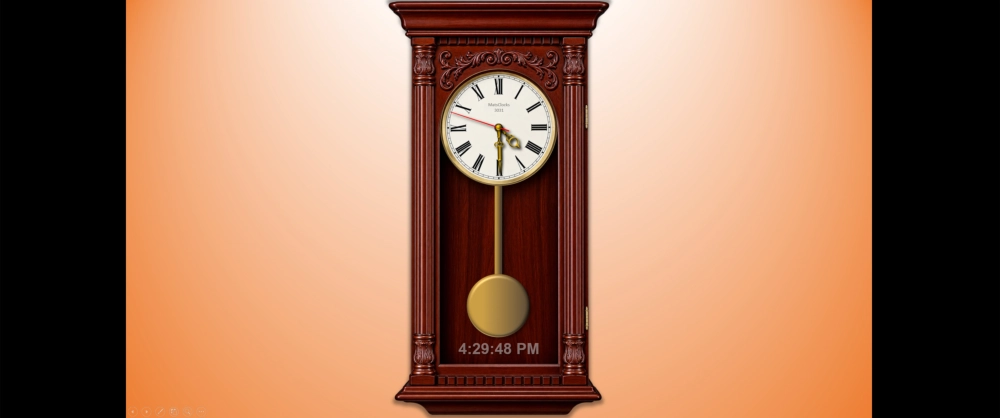
⏰ MatsClocks 3031 is a Grandfather Clock with a pendulum swinging to show live time on your PowerPoint Presentation Slide. The clock is made in mahogany wood. MatsClocks 3031 is absolutely FREE to Download and Use. You may even distribute this MatsClocks 3031 to anyone on any media without any modifications and without taking any remunerations of any kind. Let us keep these MatsClocks PowerPoint clocks absolutely free for everyone. You may create MatsClocks. But most people won't know how to do it. Hence so many MatsClocks are being given free on this website.
All MatsClocks are in Zip files which can be opened using WinZip or any common file compression program. If you do not have PowerPoint software installed in your device then please get Microsoft_Office Software with essential Office software apps like Word, PowerPoint, Excel, and One Note etc. If you already have Microsoft Office installed then please update it today to get all the latest features.
Grandfather Clock: A Remarkable Story of Time, Technology and Tradition
Few objects have the ability to make time feel almost alive. A wristwatch tells us the time. A phone displays it instantly. A digital clock changes its numbers silently. But a grandfather clock does something entirely different.
It stands tall in a room, often made from beautiful wood, with a carefully crafted clock face, swinging pendulum and exposed or hidden weights. Every tick and tock seems to announce that another moment of life has passed. Then, at the hour, its deep chime fills the room.
The grandfather clock is far more than a piece of furniture. It represents one of the most important developments in the history of mechanical time keeping. It helped bring accurate clocks into homes, businesses and public buildings, influenced the development of precision engineering, and eventually contributed to the highly synchronized world in which we live today.
But where did it come from? Who invented it? Why did it become so popular? And why does this centuries-old mechanical clock still fascinate people in an age of smartphones and atomic clocks?
What Exactly Is a Grandfather Clock?
A grandfather clock is a tall, freestanding pendulum-driven mechanical clock, traditionally enclosed in a wooden case. Most traditional examples contain a clock movement powered by hanging weights.
The weights gradually descend under gravity. Their energy drives the gears inside the clock. The pendulum regulates the movement, allowing the gears to advance at a controlled rate.
The familiar parts include:
- Clock face – displays the hours and minutes.
- Hour and minute hands – indicate the time.
- Pendulum – regulates the rate of the clock.
- Weights – provide energy to the mechanical movement.
- Gears – transfer and control the energy.
- Escapement – releases the gear train in precisely controlled increments.
- Case – protects the mechanism and gives the clock its distinctive appearance.
- Chime mechanism – produces a musical or resonant sound at selected intervals.
Some clocks have two weights, while others have three. A three-weight clock commonly has separate functions for timekeeping, striking and chiming.
The Story Begins Before the Grandfather Clock
The grandfather clock was not invented as a completely new machine.
Its story begins with the development of mechanical clocks during the Middle Ages.
Early mechanical clocks appeared in Europe several centuries before the familiar tall-case clock. They were often large, expensive machines installed in churches, monasteries, town halls and other important buildings.
These early clocks were revolutionary because they could measure the passage of time mechanically rather than relying on the position of the Sun, the movement of water or the burning of candles.
However, their accuracy was limited.
A clock could tell people approximately when an hour had passed, but keeping precise time was extremely difficult.
The great breakthrough came in the 17th century.
Galileo and the Grandfather Clock Pendulum Clock
The development of the pendulum clock is closely associated with the Italian scientist Galileo Galilei.
Galileo studied the swinging motion of pendulums and recognized that, for relatively small swings, the period of a pendulum is remarkably consistent.
According to the famous historical account, Galileo noticed this while observing a swinging lamp in a church.
He realized that a pendulum could potentially be used to regulate a clock.
Galileo never successfully completed a working pendulum clock himself, but his observations provided an important foundation for what came next.
Mr. Huygens Changed Grandfather Clock Making Forever
In 1656, Dutch scientist and mathematician Christiaan Huygens constructed the first successful pendulum clock.
This was one of the great turning points in the history of timekeeping.
Huygens combined the pendulum with a mechanical escapement. The result was dramatically more accurate than many earlier mechanical clocks.
Instead of allowing the clock's gears to run relatively freely, the pendulum and escapement controlled their movement.
The clock could now divide time into much more consistent intervals.
This improvement transformed mechanical Grandfather Clock making.
Clocks became capable of measuring time with an accuracy that earlier generations could scarcely have imagined.
From Pendulum Clock to Tall-Case Grandfather Clock
Once pendulum clocks became practical, clockmakers faced another problem.
A pendulum needs sufficient length to achieve a desired period, and the mechanical components also require space.
Clockmakers therefore began creating increasingly tall cases to accommodate the pendulum and movement.
These became known as longcase clocks.
They were not originally called grandfather clocks.
That name came much later.
The longcase design offered several advantages. The pendulum could be long and stable, the weights could descend inside the case, and the entire mechanism could be protected from accidental interference.
The result was a tall, Grandfather Clock with an elegant pendulum that could stand independently in a room.
Why Was It Called a "Grandfather Clock"?
The expression "grandfather clock" became popular in the English-speaking world much later than the invention of the long case clock.
One popular explanation involves the 1870 song "My Grandfather's Clock," written by Henry Clay Work.
The song tells the story of a large clock in a grandfather's home and helped popularize the phrase "grandfather clock."
Before this expression became common, such clocks were generally called longcase clocks, tall-case clocks, or simply pendulum clocks.
So the name "grandfather clock" is actually a relatively recent nickname for a much older type of clock.
How Does a Grandfather Clock Work?
The beauty of a traditional grandfather clock lies in the fact that it operates without batteries, electronics or a computer.
Its energy comes from gravity.
When the clock is wound, its weights are raised. As the weights descend, they release stored gravitational energy.
That energy turns gears.
But the gears cannot simply spin continuously. If they did, the clock would run down almost immediately.
The escapement solves this problem.
It releases the energy in carefully controlled steps.
The pendulum interacts with the escapement, effectively telling the mechanism when it may move forward.
Tick. Tock.
Tick. Tock.
Each swing allows the escapement to release another small amount of energy.
This controlled process moves the hands gradually around the dial.
In this way, the Grandfather Clock transforms the slow fall of a weight into the measurement of hours, minutes and seconds.
Pendulum: The Heart of a Grandfather Clock
The pendulum is perhaps the most recognizable feature of the grandfather clock.
It consists of a rod with a heavy bob at its lower end.
As the pendulum swings from one side to the other, it provides the regular rhythm required to regulate the clock.
The length of the pendulum affects its rate.
A longer pendulum swings more slowly. A shorter pendulum swings more quickly.
This relationship allowed clockmakers to fine-tune their clocks.
The pendulum also gives the grandfather clock something modern clocks rarely provide: visible evidence that time is passing.
You can actually watch the mechanism measuring time.
Why the Clock Needs Weights
The weights provide the clock's energy.
When the clock is wound, chains or cables raise the weights. As gravity pulls them downward, the resulting force drives the clock mechanism.
Depending on the design, a clock may have separate weights for:
- Timekeeping
- Striking the hours
- Operating the musical chime
Eventually the weights reach the bottom of their travel and the clock stops.
The owner must then wind it again by raising the weights.
This ritual became part of owning a mechanical clock.
The Wonderful Sound of the Grandfather Clock
The sound of a grandfather clock is almost as famous as its appearance.
Many traditional clocks strike or chime at regular intervals.
Some announce the hour with a deep, resonant strike. Others play elaborate musical sequences.
The best-known melodies include Westminster-style chimes, inspired by the famous clock chimes associated with the Palace of Westminster in London.
The sound transformed the clock from a simple timekeeping instrument into something that became part of the atmosphere of a home.
A grandfather clock did not merely tell you that it was ten o'clock.
It announced the arrival of ten o'clock.
How Grandfather Clocks Changed Society
The importance of the mechanical clock extends far beyond decoration.
Accurate mechanical timekeeping changed how people organized their lives.
Before mechanical clocks became widespread, daily activities were often closely associated with daylight, seasons and religious schedules.
As mechanical clocks became more accurate and accessible, society increasingly began organizing activities according to precise clock time.
Work could begin at a particular hour.
Markets could operate according to schedules.
Meetings could be arranged more precisely.
Schools could establish timetables.
Transportation could follow published schedules.
Factories could organize shifts.
Governments and institutions could coordinate activities.
The clock gradually changed humanity's relationship with time.
Grandfather Clock and the Industrial Revolution
The importance of accurate timekeeping became even greater during the Industrial Revolution.
Factories required workers to arrive at particular times and work for defined periods.
Machines operated according to schedules.
Railways needed reliable timetables.
Businesses needed appointments and deliveries to occur at predictable times.
As transportation networks expanded, synchronized clocks became increasingly important.
The mechanical clock therefore became part of the infrastructure of modern economic life.
The grandfather clock itself was primarily a household and decorative form of timekeeper, but it belonged to the larger technological revolution that made precise mechanical timekeeping possible.
Grandfather Clocks and the Railway Age
The growth of railways created an enormous demand for accurate and synchronized time.
A few minutes of discrepancy that might once have been unimportant could become a serious problem when trains were travelling according to schedules.
Railways therefore encouraged greater standardization of time.
This eventually contributed to the widespread adoption of standardized time zones and coordinated timekeeping.
The world was becoming increasingly connected, and clocks had to keep pace.
The Grandfather Clock as a Status Symbol
There was another reason these clocks became popular.
They were beautiful.
A quality grandfather clock could be expensive and required considerable craftsmanship.
The wooden cabinet could be made from valuable timber and decorated with carved details, glass panels, polished surfaces and intricate moldings.
Owning one demonstrated wealth, sophistication and an appreciation for craftsmanship.
The clock often occupied a prominent position in the home.
It was not hidden away.
It was meant to be seen.
The Grandfather Clock as Family Heritage
Over time, grandfather clocks acquired an emotional significance that went far beyond their technical function.
A Grandfather Clock might be purchased by a newly married couple.
Decades later, it could become a treasured possession of their children.
Eventually, it might be passed to grandchildren.
The Grandfather Clock therefore became a physical link between generations.
Every scratch, repair and imperfection could become part of its history.
Unlike an inexpensive modern electronic clock, a traditional mechanical clock could remain functional for generations if properly maintained.
That gave the grandfather clock a special place in family history.
Benefits of a Grandfather Clock
1. Exceptional Craftsmanship
Traditional grandfather clocks showcase mechanical engineering, woodworking, metalworking and decorative craftsmanship.
2. Long Service Life
A well-made mechanical clock can potentially operate for many decades or even centuries with proper maintenance and replacement of worn components.
3. No Batteries
Traditional weight-driven clocks do not require batteries.
Their energy comes from gravity.
4. Educational Value
A grandfather clock provides an excellent demonstration of gears, mechanical energy, escapements, pendulums and basic physics.
5. Beautiful Decoration
A well-designed grandfather clock can become a major architectural feature of a room.
6. Audible Timekeeping
The ticking, striking and chiming provide an unmistakable sense of time.
7. Emotional and Historical Value
Older clocks can carry family stories and historical significance.
8. Potential Collectible Value
Certain antique clocks made by respected clockmakers can become valuable collectibles.
However, value depends heavily on authenticity, condition, provenance, maker, rarity and originality.
The Drawbacks of Grandfather Clocks
Despite their beauty, grandfather clocks are not perfect.
1. They Are Large
A grandfather clock requires significant floor and vertical space.
It may not be suitable for a small modern apartment.
2. They Require Maintenance
Mechanical movements contain many moving parts.
Oil can deteriorate, components can wear and the movement may eventually require professional servicing.
3. Grandfather Clock Must Be Wound
Traditional weight-driven clocks need periodic winding.
Depending on the movement, this may be required approximately once a week or according to the specific design.
4. They Can Lose or Gain Time
Mechanical clocks are affected by factors such as temperature, friction, pendulum adjustment, movement condition and whether the clock is properly level.
They are not normally as accurate as quartz or electronic clocks.
5. They Can Be Sensitive
Moving a grandfather clock incorrectly can affect its alignment or damage the movement.
6. They Can Be Expensive
Quality Grandfather Clock require skilled craftsmanship and precision components.
Antique clocks can also be expensive to restore.
7. The Chimes Can Be Unwelcome
The same beautiful sound that charms one person may disturb another, particularly at night.
Fortunately, many clocks allow their chime or strike functions to be silenced.
Grandfather Clock Versus Modern Clock
From a purely practical perspective, the grandfather clock has been surpassed.
A quartz clock can be much more accurate.
A smartphone can automatically synchronize with network time.
An atomic clock can maintain extraordinarily precise time.
So why would anyone want a grandfather clock?
Because the grandfather clock provides something that digital technology cannot easily replace.
Experience.
A digital clock gives you a number.
A grandfather clock gives you a relationship with time.
You hear it.
You see its pendulum move.
You wind it.
You adjust it.
You maintain it.
And eventually, you may pass it to somebody else.
The Grandfather Clock and the Philosophy of Time
Perhaps the deepest appeal of the grandfather clock is philosophical.
Its slow ticking reminds us that time does not stop.
The pendulum moves backward and forward, but the clock itself advances continuously.
The weights gradually descend.
The hands slowly travel around the dial.
The chimes arrive and disappear.
The clock becomes a physical representation of something humans cannot see: the passage of time.
In a world filled with instant messages, streaming video, smartphones and artificial intelligence, this slow mechanical rhythm can feel strangely comforting.
It encourages us to pause.
Listen.
And notice time.
Grandfather Clocks in Modern Homes
Although grandfather clocks are no longer essential household timekeepers, they remain popular as decorative and sentimental objects.
Modern versions can combine traditional appearance with quartz or electronic movements.
Some reproduce the appearance of traditional mechanical clocks while requiring little maintenance.
Others remain entirely mechanical and are purchased by enthusiasts who appreciate traditional clock making.
Collectors may search for clocks from famous makers, unusual movements, rare cases or historically significant examples.
Famous Clock Makers
Over the centuries, numerous clockmakers contributed to the development of longcase clocks and precision timekeeping.
British clockmakers became particularly renowned for their craftsmanship.
Names such as Thomas Tompion, George Graham, Thomas Mudge and later makers became associated with important advances in precision clockmaking.
The great clockmaking traditions of England, France, Germany, Austria and other European regions produced distinctive designs and mechanisms.
Each region developed its own styles of cases, dials, movements and decorative details.
The Grandfather Clock and Precision Engineering
The grandfather clock is also a lesson in engineering.
Consider what must happen inside a traditional movement.
A source of energy must drive the system.
Gears must transmit that energy.
The escapement must regulate it.
The pendulum must maintain a predictable rhythm.
The hands must move at the correct relative speeds.
The striking mechanism must operate at the appropriate times.
The chime mechanism must perform its sequence.
All of this happens using mechanical components rather than electronic processors.
That is an extraordinary achievement of engineering.
Why the Grandfather Clock Still Matters
The grandfather clock is no longer necessary for determining the correct time.
But its historical importance remains.
It represents the centuries-long human effort to measure time more accurately.
That effort eventually led from sundials and water clocks to mechanical clocks, pendulum clocks, marine chronometers, quartz clocks, radio-controlled clocks, GPS timing and atomic clocks.
Modern civilization depends upon extraordinarily precise time.
Computer networks, telecommunications, navigation systems, financial transactions, satellites and scientific experiments all depend on synchronized timing.
The grandfather clock belongs to an important chapter in that extraordinary journey.
How to Care for a Grandfather Clock
If you own a traditional grandfather clock, proper care can significantly extend its life.
Keep it away from extreme temperatures and excessive humidity.
Avoid placing it where it receives strong direct sunlight for long periods.
Make sure the clock is properly leveled.
Do not move it without securing the pendulum and other components according to the manufacturer's instructions.
Do not attempt to flood the movement with household oil. Mechanical clock movements require appropriate lubricants and professional servicing.
Most importantly, have an antique or valuable clock serviced by a qualified clockmaker when necessary.
Grandfather Clock: A Machine That Became a Memory
Perhaps the most remarkable thing about the grandfather clock is that it began as technology and became tradition.
When early clockmakers developed increasingly accurate mechanical clocks, they were solving an engineering problem.
But generations later, people began seeing these clocks differently.
The clock became part of the household.
It witnessed births, marriages, celebrations, arguments, illnesses and farewells.
It stood quietly in the corner while children grew into adults.
It continued ticking when generations changed.
And when the original owner was gone, the clock sometimes remained.
That is why a grandfather clock can have value even when it is no longer the most accurate clock in the house.
Its greatest value may not be measured in seconds.
It may be measured in memories.
Final Words on Grandfather Clocks
The grandfather clock is one of the most fascinating examples of technology becoming part of human culture.
Its roots lie in the development of mechanical clocks and the scientific discovery that a pendulum could provide a remarkably consistent rhythm. Christiaan Huygens' successful pendulum clock in the 17th century transformed timekeeping, and the longcase clock subsequently brought this technology into homes.
The Grandfather Clock helped symbolize a world increasingly governed by precise time. As commerce, transportation, industry and communication expanded, accurate timekeeping became increasingly important to modern civilization.
Yet the grandfather clock represents more than technological progress.
It represents craftsmanship.
It represents patience.
It represents engineering.
It represents family.
And above all, it represents our fascination with time itself.
A smartphone can tell you that it is 6:30.
A grandfather clock can make you feel that another minute has passed.
Its pendulum swings.
Its gears turn.
Its hands move.
Its weights descend.
And somewhere inside that beautifully crafted wooden case, a centuries-old idea continues to work exactly as its inventors intended:
To turn the invisible passage of time into something we can see, hear and remember.
Next Clock
>>
If you do not have PowerPoint software installed in your device then
please get
Microsoft_Office Software with essential Office
software apps like Word, PowerPoint, Excel, and One Note etc. If you
already have Microsoft Office installed then please update it today to get
all the latest features.