 MatsClocks
PowerPoint Presentation Clocks
Wall Clock Live Time
MatsClocks 3030 Displays Live Time on a Beautiful Wall Clock
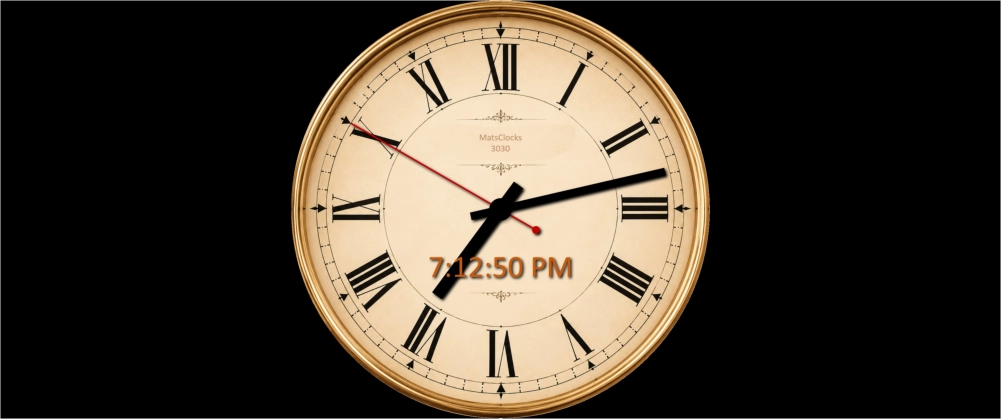
⏰ MatsClocks 3030 is a beautiful Wall Clock that displays live time on your PowerPoint Presentation Slide. MatsClocks 3030 is absolutely FREE to Download and Use. You may even distribute this MatsClocks 3030 to anyone on any media without any modifications and without taking any remunerations of any kind. Let us keep these MatsClocks PowerPoint clocks absolutely free for everyone. But most people won't know how to make a live clock in a PowerPoint presentation slide. Hence, we are providing so many MatsClocks for free on this MatsClocks.com website.
All MatsClocks are in Zip files which can be opened using WinZip or any common file compression program. If you do not have PowerPoint software installed in your device then please get Microsoft_Office Software with essential Office software apps like Word, PowerPoint, Excel, and One Note etc. If you already have Microsoft Office installed then please update it today to get all the latest features.
Wall Clocks: The Fascinating History, Technology, Benefits and Evolution of a Timeless Invention
A wall clock is one of those everyday objects that we often stop noticing, until we need to know the time. Hanging quietly on a wall in a home, classroom, railway station, office, factory, hotel or public building, it performs a remarkably important task: it gives us a visible reference to the passing of time.
Unlike a wristwatch, a wall clock is designed to be seen by several people at once. Unlike a smartphone, it does not require a battery-powered screen to be switched on or an app to be opened. And unlike a computer, it normally performs one simple job without distractions. For centuries, the wall clock has combined practical timekeeping with craftsmanship, engineering and, increasingly, interior decoration.
But why were clocks put on walls in the first place? How did the technology develop from enormous mechanical machines to tiny quartz movements? Why do some clocks tick while others appear completely silent? And in an age when almost everyone carries a smartphone, does the wall clock still have a purpose?
The story of the wall clock provides fascinating answers.
Why Was the Wall Clock Invented?
The wall clock was not invented simply because someone wanted a beautiful object to hang on a wall. Its origins are closely connected with humanity's growing need to measure and organize time.
Ancient civilizations had already developed ways of measuring time using the movement of the Sun, water, sand and eventually mechanical mechanisms. Sundials could indicate approximately what time it was during daylight, while water clocks could measure intervals of time even when the Sun was not visible.
But these devices had limitations.
A sundial could not work at night or in cloudy conditions. Water clocks required careful construction and maintenance. People increasingly needed a reliable method of measuring time that could operate continuously and display the result clearly.
Mechanical clocks provided the answer.
As mechanical clock technology developed during the Middle Ages, large clocks were installed in churches, monasteries, civic buildings and other prominent structures. These clocks were expensive, complicated machines, and their size meant that they were initially associated with public buildings rather than ordinary homes.
The concept behind a wall clock was wonderfully practical: put the wall clock at eye level or in a prominent location so that everyone in a room can see the time.
A single clock could therefore serve an entire household, classroom, workshop or office.
This was particularly important before inexpensive personal watches became widely available.
The Early History of Mechanical Clocks
The history of the wall clock cannot be separated from the history of the mechanical clock.
Mechanical clocks emerged in Europe during the late medieval period, particularly around the 13th and 14th centuries. The exact origins are complex, and there was no single inventor who can reasonably be described as "the inventor of the mechanical clock."
Early mechanical clocks used a system of gears and weights. A descending weight supplied energy, while a regulating mechanism controlled how quickly that energy was released.
One of the most important developments was the escapement.
The escapement allowed the gear train to advance in controlled steps rather than spinning freely. This transformed a simple collection of gears into a practical timekeeping mechanism.
Early mechanical clocks were not especially accurate by modern standards. Their purpose was nevertheless revolutionary: they could provide a continuous mechanical indication of time without depending on sunlight.
Large public clocks soon became symbols of technological achievement and civic importance.
From Tower Clocks to Household Clocks
The earliest large mechanical clocks were generally installed in towers and public buildings.
A clock tower served an entire community. Bells could announce the hours even to people who could not see the clock face.
As clock making technology improved, mechanisms became smaller.
This miniaturization was enormously important.
Clockmakers gradually developed smaller mechanisms that could be installed inside buildings and eventually inside private homes. Weight-driven clocks evolved into more compact designs, and later spring-powered mechanisms made clocks considerably easier to place in different locations.
By the 17th and 18th centuries, clocks had become increasingly common household objects among wealthier families.
The wall became a natural location.
A wall clock could occupy relatively little furniture space while remaining visible to everyone in the room.
The Pendulum Revolution
One of the greatest milestones in clockmaking occurred in the 17th century.
In 1656, Dutch scientist and mathematician Christiaan Huygens developed the first practical pendulum clock.
The principle was based on the regular oscillation of a pendulum. Galileo Galilei had earlier investigated the properties of pendulums, but Huygens successfully incorporated the principle into a working clock.
The improvement in accuracy was dramatic.
A pendulum provided a much more consistent regulator than many earlier systems. The clock's mechanism could therefore divide time into more regular intervals.
This development transformed mechanical clock making.
Pendulum clocks became famous for their precision and elegance. Long-case clocks—later popularly associated with grandfather clocks, used long pendulums to regulate their mechanisms.
Wall clocks could also incorporate pendulum mechanisms, producing the characteristic rhythmic movement and ticking that became associated with traditional clocks.
The Rise of the Wall Clock
As clocks became smaller, more affordable and more reliable, wall-mounted designs became increasingly popular.
The wall clock had several practical advantages.
A clock mounted on the wall could be positioned where it was visible from multiple parts of a room. It did not occupy a table or desk. It could also be made relatively large, allowing the numerals and hands to be read from a distance.
Factories, railway stations, schools, offices and public institutions particularly benefited from this arrangement.
The clock became more than a timekeeping device. It became part of the organization of society.
Workers needed to know when shifts began and ended. Railway passengers needed schedules. Schools needed bells and timetables. Businesses needed standardized working hours.
The humble wall clock became an important visual symbol of an increasingly time-conscious industrial society.
The Industrial Revolution and the Importance of Accurate Time
The Industrial Revolution dramatically increased the importance of accurate timekeeping.
Before industrialization, daily life in many communities was governed largely by natural cycles. Agriculture, daylight and local customs played major roles.
Factories changed this.
Machines operated according to schedules. Workers were expected to arrive at specific times. Trains had timetables. Businesses needed coordinated opening and closing hours.
Time became an economic resource.
A few minutes could matter when thousands of workers, machines and transportation services were involved.
Large wall clocks became common in factories, railway stations and workplaces because they provided a shared time reference.
The wall clock therefore became part of the infrastructure of modern society.
The Development of Electric Clocks
Mechanical clocks dominated for centuries, but electricity eventually changed clock technology.
Electric clocks began appearing in the late 19th and early 20th centuries.
Instead of relying entirely on falling weights or wound springs, an electrical system could provide energy to the clock mechanism.
Some electric clocks retained mechanical components while using electricity to power or regulate them.
The development of electrical timekeeping also opened the door to more sophisticated synchronization systems.
Clocks could increasingly be synchronized to a common reference, an important development for railways, telecommunications, factories and scientific institutions.
The Quartz Clock Revolution
The next major transformation came with quartz technology.
Quartz crystal has a remarkable property known as the piezoelectric effect. When an electrical voltage is applied to a quartz crystal, it vibrates at a highly stable frequency.
Clockmakers discovered that these vibrations could be used as a precise timing reference.
A typical quartz wall clock uses a small electronic circuit to excite a quartz crystal, commonly at a frequency of 32,768 vibrations per second.
Why 32,768?
Because it allows a digital circuit to repeatedly divide the frequency by two until it produces exactly one pulse per second.
That one-second signal can then drive a small motor that moves the clock hands.
This is an elegant combination of physics, electronics and mechanical engineering.
How Does a Modern Wall Clock Work?
A modern wall clock may look simple from the outside, but several components work together inside it.
A typical battery-powered quartz wall clock contains:
- A battery
- An electronic oscillator circuit
- A quartz crystal
- Frequency-divider circuitry
- A small electromagnetic motor
- A gear train
- Clock hands
- A dial or display
The battery supplies electrical energy.
The quartz crystal provides a stable oscillation.
The electronic circuit divides that oscillation into regular time intervals.
The motor converts electrical pulses into mechanical movement.
The gears reduce and control the motor's rotation so that the hour, minute and second hands move at the correct rates.
The entire mechanism can be extremely small and inexpensive.
Why Does a Quartz Clock Tick?
Many traditional quartz wall clocks use a motor that advances the second hand once per second.
This produces the familiar:
Tick... tick... tick...
The second hand moves in individual steps because the motor receives discrete electrical pulses.
Some clocks, however, use a movement designed for continuous or near-continuous sweeping.
In these clocks, the second hand appears to glide smoothly around the dial.
The difference is primarily mechanical and electronic rather than a difference in the fundamental concept of quartz timekeeping.
Why Do Some Wall Clocks Have No Second Hand?
A wall clock does not necessarily need a second hand.
The hour and minute hands provide sufficient information for many everyday applications.
Removing the second hand can also create a quieter and more minimalist design.
In offices, bedrooms and libraries, a silent wall clock can be particularly desirable because the repeated ticking of a traditional clock can become distracting.
Mechanical Wall Clocks
Not every wall clock uses quartz.
Mechanical wall clocks remain popular because they offer something that electronic clocks often lack: mechanical character.
A mechanical clock generally contains:
- An energy source
- A gear train
- An escapement
- A regulator
- A display mechanism
The energy source may be a wound spring or a weight.
The gear train transfers this energy.
The escapement controls the release of energy.
The regulator determines the rate.
The hands indicate the resulting time.
This is a miniature machine performing a carefully coordinated sequence of mechanical operations.
The Role of Gears in Wall Clock
Gears are fundamental to mechanical clocks.
The hands need to rotate at different speeds.
The minute hand must complete one revolution in one hour.
The hour hand must complete one revolution in approximately twelve hours.
If there is a second hand, it must complete one revolution in one minute.
The gear train establishes these relationships.
In a traditional mechanical clock, dozens of carefully designed teeth may work together to transform the relatively fast motion of one component into the extremely slow and controlled motion required by the clock hands.
The Escapement: The Heart of a Mechanical Clock
The escapement is one of the most ingenious components of a mechanical clock.
Without it, the stored energy in the spring or weight would cause the gears to turn rapidly.
The escapement releases that energy in controlled increments.
In a pendulum clock, the pendulum interacts with the escapement, allowing the gear train to advance by precise steps.
The familiar ticking sound is partly the audible consequence of this controlled mechanical process.
The escapement therefore performs two critical functions:
It regulates the release of energy and helps establish the clock's rate.
The Pendulum Wall Clock
The pendulum is both a technical component and one of the most recognizable symbols of traditional clock making.
A pendulum swings back and forth at a rate determined primarily by its length and local gravitational acceleration.
For a simple pendulum, the approximate period is:
T = 2π√(L/g)
where:
- T is the period of oscillation,
- L is the pendulum length,
- g is gravitational acceleration.
This relationship allows clockmakers to design pendulums that oscillate at useful rates.
Temperature, air resistance, friction and changes in gravity can nevertheless influence the accuracy of mechanical clocks.
The Wall Clock and Standardized Time
Wall clocks played an important role in making standardized time visible.
Before modern time zones, local solar time differed from place to place. Noon occurred when the Sun reached its highest point locally.
The development of railways and long-distance communication made this arrangement increasingly inconvenient.
Standard time zones eventually provided a common reference across large regions.
Wall clocks installed in railway stations, businesses, schools and public buildings made standardized time something people could see and follow.
The clock on the wall became a visible representation of the increasingly synchronized modern world.
Benefits of Wall Clocks
Despite the availability of smartphones and computers, wall clocks still offer many advantages.
1. Immediate Visibility
A wall clock can be seen at a glance.
You do not need to unlock a phone, open an application or activate a screen.
2. Shared Time Reference
A single clock can serve an entire room.
This makes wall clocks particularly useful in:
- Classrooms
- Offices
- Factories
- Hospitals
- Workshops
- Kitchens
- Meeting rooms
- Reception areas
3. Fewer Distractions
Looking at a wall clock does not normally expose you to notifications, emails, social media or advertisements.
Checking a smartphone for the time can easily become a much longer interaction.
4. Large and Readable
Wall clocks can have large numerals and hands, making them readable from considerable distances.
5. No Internet Required
A conventional quartz wall clock does not need Wi-Fi or cellular connectivity.
It can continue operating even when the internet is unavailable.
6. Low Energy Consumption
A simple quartz wall clock can run for a long time on a single battery.
Its energy requirements are tiny compared with many electronic devices.
7. Wall Clock Decorative Value
Modern wall clocks can be works of interior design.
Wooden clocks, metal clocks, minimalist clocks, vintage clocks and artistic clocks can all contribute to the appearance of a room.
8. Educational Value of a Wall Clock
An analog wall clock can help children understand:
- Hours
- Minutes
- Seconds
- Fractions
- Angles
- Daily schedules
Reading an analog clock is also an excellent introduction to the concept of measuring continuous time using a circular scale.
Drawbacks of Wall Clocks
Wall clocks are not perfect.
1. Limited Portability
A wall clock is designed to stay in one place.
If you move to another room or leave the building, you cannot take advantage of its display.
2. Battery Replacement
Quartz clocks require batteries.
Although the battery may last many months or even longer, it eventually needs replacement.
3. Mechanical Maintenance
Mechanical wall clocks require considerably more care.
They may need cleaning, lubrication, adjustment and professional servicing.
4. Accuracy Limitations
Inexpensive quartz clocks are generally very accurate for everyday use, but they are not perfect.
Mechanical clocks can experience larger variations due to temperature, friction, position and other environmental factors.
5. Ticking Noise
Some clocks produce an audible ticking sound.
This may be charming to some people but irritating to others.
6. Wall Space
A wall clock occupies a permanent section of wall space.
In a minimalist interior, even a beautiful clock may be considered unnecessary visual clutter.
7. It Can Become a Distraction
A prominent clock can sometimes make people overly conscious of time—particularly in stressful environments such as examination rooms or workplaces.
Wall Clocks in Schools
The wall clock has an especially important role in education.
A classroom clock allows students and teachers to share a common understanding of time.
It helps organize lessons, breaks, examinations and activities.
For younger children, the analog clock also provides a visual demonstration of the relationship between numbers, angles and elapsed time.
The clock therefore serves both a practical and educational purpose.
Wall Clocks in Offices and Workplaces
In an office, a wall clock can establish a common time reference without requiring every employee to check a personal device.
Meetings, appointments and work schedules can be coordinated using a shared visual display.
In factories and industrial environments, large wall clocks can be particularly useful because they remain visible from a distance.
Specialized clocks may also include synchronized displays, timers or multiple time zones.
Wall Clocks in Public Places
Some of the most memorable clocks are found in public spaces.
Railway stations, airports, museums, town halls and hotels often use prominent clocks because thousands of people need to know the time.
In such places, the clock becomes part of the architecture.
It can also become a landmark.
A famous clock may eventually be remembered as much for the place in which it is installed as for its timekeeping function.
Analog Versus Digital Wall Clocks
The development of digital electronics introduced another choice.
An analog wall clock represents time using hands moving around a dial.
A digital clock represents time numerically, such as:
10:35:42
Both approaches have advantages.
An analog clock provides an intuitive visual representation of the passage of time. The position of the hands immediately conveys whether it is early, middle or late within an hour.
A digital clock provides exact numerical information and can be easier to read quickly.
For this reason, both designs remain popular.
Smart Wall Clocks
The modern wall clock is also entering the digital age.
Some contemporary clocks can connect to networks and display more than time.
Depending on the design, a smart clock may provide:
- Weather information
- Calendar reminders
- Multiple time zones
- Internet-synchronized time
- Temperature
- Humidity
- Alarms
- Notifications
- Automatic brightness adjustment
Some sophisticated systems can automatically synchronize themselves with internet time servers or other highly accurate references.
The traditional wall clock is therefore evolving rather than disappearing.
Radio-Controlled and Synchronized Wall Clocks
Another interesting development is the radio-controlled clock.
These clocks receive time signals transmitted from specialized timekeeping stations.
The clock periodically corrects itself so that it remains synchronized with the reference time.
This eliminates much of the need for manual adjustment.
Some modern clocks instead synchronize through the internet or satellite-based systems.
This is particularly valuable when many clocks need to display the same time.
The Wall Clock as an Interior Design Object
The wall clock has gradually evolved from a purely functional instrument into a decorative object.
A traditional wooden clock can create a feeling of warmth and history.
A large metal clock can give an industrial appearance.
A minimalist clock can blend into a modern interior.
A richly decorated clock can become the focal point of a room.
This is one reason wall clocks have survived the smartphone era.
People do not necessarily buy a beautiful wall clock because they lack another way of finding the time.
They buy it because they like having a clock on the wall.
Why Wall Clocks Have Survived the Smartphone
This may be the most interesting question of all.
Almost everyone with a smartphone already carries an extremely accurate clock.
Why, then, do wall clocks continue to exist?
Because convenience and function are not the only reasons humans keep objects.
A wall clock provides information passively.
You can glance at it while cooking, working, teaching or walking through a room.
It does not demand interaction.
It does not need to be unlocked.
It does not distract you with notifications.
And it can be seen by everyone.
There is also something emotionally satisfying about watching physical hands move around a dial.
The wall clock makes time visible.
A smartphone tells you the time.
A wall clock shows you time passing.
The Psychology of the Wall Clock
Clocks influence how people experience their environment.
A visible clock can make people more aware of deadlines and schedules.
In schools and workplaces, this can encourage punctuality.
In waiting rooms, however, a clock can sometimes make people more conscious of how long they have been waiting.
This illustrates an interesting feature of clocks: they do not merely measure time. They influence our relationship with it.
The clock turns an invisible process into something visible.
The Future of the Wall Clock
The future wall clock will probably combine traditional design with modern technology.
We may see more clocks with:
- Automatic time-zone adjustment
- Internet synchronization
- Solar power
- Energy-efficient displays
- E-ink screens
- Environmental sensors
- Smart-home integration
- Multiple time-zone displays
- Voice assistance
- Personalized information displays
Yet traditional clocks are unlikely to disappear completely.
Mechanical clocks will continue to attract enthusiasts and collectors.
Classic wooden clocks will remain part of traditional interiors.
Simple quartz clocks will continue to provide inexpensive and dependable timekeeping.
And modern designer clocks will continue to decorate homes and offices.
The Wall Clock: A Remarkable Journey
The wall clock is much more than a circular dial with two or three hands.
It represents centuries of human curiosity about time.
From ancient attempts to measure the movement of the Sun to medieval mechanical clocks, from Huygens' pendulum to electrical mechanisms, from quartz crystals to radio-controlled and network-connected clocks, the technology has undergone extraordinary changes.
Yet the fundamental purpose of a Wall Clock has remained remarkably consistent:
to make time visible and understandable.
The wall clock helped societies organize work, transportation, education and commerce. It brought accurate time into homes, schools and workplaces. It became a symbol of punctuality and discipline, an educational instrument, an engineering achievement and eventually a piece of interior decoration.
Perhaps the greatest achievement of the wall clock is its simplicity.
In a world filled with complicated technology, a wall clock can still do its job with extraordinary elegance.
A battery powers a tiny circuit. A quartz crystal vibrates thousands of times every second. Electronics count those vibrations. A small motor turns gears. The gears move the hands.
And, almost silently, the clock continues its journey around the dial.
One second at a time.
One minute at a time.
One hour at a time.
The wall clock reminds us of something that technology can measure but never stop:
Time is always moving forward.
And perhaps that is why, even after centuries of technological change, we still find a place for a clock on the wall.
Next Clock
>>
If you do not have PowerPoint software installed in your device then
please get
Microsoft_Office Software with essential Office
software apps like Word, PowerPoint, Excel, and One Note etc. If you
already have Microsoft Office installed then please update it today to get
all the latest features.