 MatsClocks
PowerPoint Presentation Clocks
⏰ Turkey Time Now
Live Turkey Time Now Clock PowerPoint Presentation Slide
Download
Turkey Time Now Clock
Next Clock >>
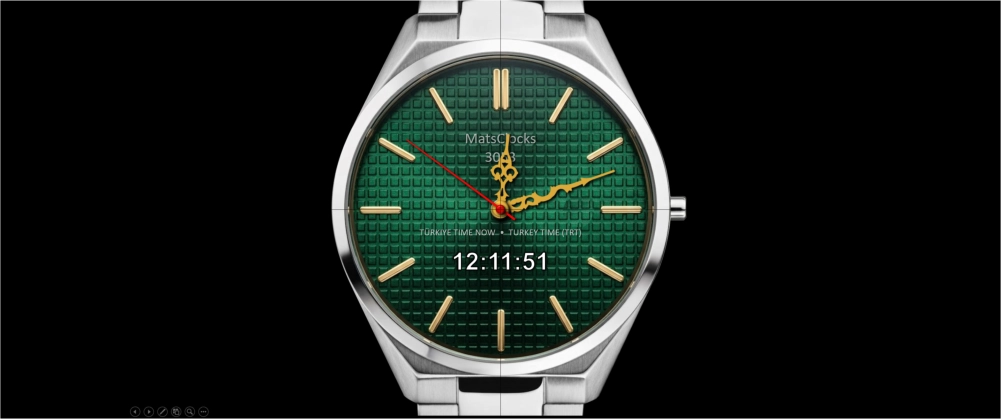
MatsClocks 3058 Turkey Time Now Clock displays Live Turkey Time Now on your PowerPoint Presentation Slide in both analog clock and a digital clock next to it, irrespective of which country in the world you run this PowerPoint Slide. MatsClocks 3058 caters for Daylight Saving Time automatically and this PowerPoint Clock starts running the moment you go to presentation mode. Every Whole Hour, this clock chimes a beautiful bell sound. All MatsClocks are in Zip files which can be opened using WinZip or any common file compression program. Get the latest Microsoft_Office Software to run PowerPoint on your devices.
Turkey Time: A Guide to Turkey Time Zone, Cities, Culture and Traditions
In Istanbul, morning might begin with a ferry crossing the Bosphorus, tea poured into a tulip-shaped glass and the city slowly waking along both shores. In Cappadocia, it may start beneath a sky dotted with hot-air balloons. The clock reads the same in both places, but the feel of the day changes with the landscape. Turkey Time is the country’s shared time zone; Turkey has many local rhythms are what make it memorable.
If you’re planning a visit or simply curious about Turkey, it helps to know both how the clock works and what life around it can look like. Turkey uses one time zone nationwide, so İstanbul, Ankara, İzmir, Antalya, Trabzon and the country’s other cities all follow the same official time.
What is Turkey Time Now?
Turkey observes Turkey Time, commonly abbreviated TRT, at UTC+3 throughout the year. The country does not currently move its clocks forward or back for seasonal daylight saving time. That means the official time in İstanbul is the same as in the eastern city of Van, even though sunrise and sunset naturally happen at different local times across the country.
For travellers, the arrangement is straightforward: you don’t need to adjust your watch when flying from İzmir to Gaziantep or taking a train between Ankara and Konya. Still, check the local time shown on your booking or meeting invitation, especially when coordinating with people abroad. Phones and computers usually update automatically when connected to a network.
From Sunset Clocks to a National Standard
The story of time in Turkey reaches back before today’s digital clocks and printed timetables. In the late Ottoman period, one familiar system was alaturka, also called ezanî time. Instead of counting a fixed day from midnight, this local system set twelve o’clock at sunset. Because sunset shifts with the seasons, the clock’s relationship to daylight changed over the course of the year.
Another system, alafranga time, followed a more widely shared European-style standard. As new forms of administration and communication grew, the two ways of keeping time could exist side by side. A scholarly study of Ottoman clocks describes how official services such as the postal service and telegraph had to deal with the practical challenges of coordinating between systems.
A major change came with Law No. 697, the 1925 Law on the Division of the Day into Twenty-Four Hours. It established that the day would begin at midnight, with hours counted from zero to twenty-four, and set a common reference meridian near İzmit. The law appeared in the Official Gazette on January 2, 1926.
For decades, Turkey followed a seasonal clock pattern, using UTC+2 in winter and moving to UTC+3 in summer. In 2016, the government decided to keep the summer-time setting throughout the year. The Ministry of Energy and Natural Resources says the policy was intended to make more daylight available during working hours, reduce clock changes and support energy savings. It currently reports no decision or preparation to change the policy.
Modern Turkey Time and Everyday Life
The move from sunset-based local time to one national standard changed more than what people saw on a clock face. A shared Turkey Time system makes it easier to coordinate transport, public services, work and communication across a country with cities spread over a wide area. Today, airline schedules, online bookings, phones and business calendars all rely on standard time conventions.
The national clock also sits alongside the sun’s local schedule. In winter, early mornings can feel dark in western parts of the country, while eastern cities see daylight earlier. The official time stays the same nationwide, but everyday routines still respond to the season, the weather and the neighbourhood. For visitors, that’s a useful reminder: a timetable tells you when something starts, while the local atmosphere tells you how the day unfolds.
Cities that show different sides of Turkey
Turkey cities are distinct in pace, landscape and character. İstanbul is a natural starting point for many visitors: a vast, energetic metropolis with ferries, markets and historic neighbourhoods beside modern districts. The city’s historic areas preserve monuments shaped by successive empires, including Hagia Sophia and the Süleymaniye Mosque. (UNESCO’s overview of the Historic Areas of Istanbul)
Ankara, the capital, offers a different perspective, with national museums, government institutions and the Anıtkabir mausoleum. İzmir, on the Aegean coast, is known for its waterfront, lively markets and access to ancient sites. Bursa combines Ottoman-era landmarks with green mountain scenery, while Antalya brings together a historic old town, Mediterranean beaches and nearby archaeological remains.
Further inland, Konya is associated with Seljuk architecture and the Mevlevi tradition. Gaziantep draws visitors for its food and craft heritage. Mardin is admired for its stone architecture and broad Mesopotamian views; Diyarbakır for its historic walls and old quarters. Along the Black Sea, Trabzon offers green coastal landscapes and access to the celebrated Sümela Monastery. Van, beside its namesake lake in eastern Turkey, has a striking setting and a long regional history.
These are only a selection of the country’s cities. From Edirne in the west to Şanlıurfa in the southeast, and from the Aegean coast to the Black Sea highlands, each region adds its own character to the larger picture. Turkey Ministry of Culture and Tourism describes its culture as a blend shaped by many communities and historical influences, with traditions and expressions that vary from city to city.
Culture, People and Traditions
Daily life in Turkey can be welcoming in small, ordinary ways. A shopkeeper may offer tea during a conversation; friends might linger over breakfast; dinner can stretch into a long evening of shared plates and stories. These gestures aren’t identical everywhere, and no single custom represents every person or community. Rather, they offer a glimpse of social life that visitors may encounter in many parts of the country.
Food is one of the clearest ways to experience regional variety. A breakfast table might include bread, olives, cheese, tomatoes, eggs and tea. Meals can bring together meze, grilled dishes, vegetables, seasonal produce and desserts such as baklava. Turkish coffee has its own careful preparation and social rituals, and its culture is recognized on UNESCO’s Intangible Cultural Heritage list. The tradition links the drink with conversation, hospitality and special occasions.
Tea also has a central place in everyday hospitality. Other living traditions range from the Mevlevi Sema ceremony associated with Konya to the Karagöz shadow-puppet theatre and regional music and dance. Celebrations and festivals vary across the calendar and the country: Nevruz marks spring in many communities, while weddings may bring neighbours and relatives together for music, dancing and shared meals. The styles differ by region, family and occasion; asking a host or local guide about a custom is often the best way to understand it respectfully.
Places to Visit in Turkey
For history and architecture, begin with İstanbul’s historic peninsula, then consider Bursa, Edirne or the archaeological sites of the Aegean. Ephesus, near İzmir, offers monumental remains from the ancient world. Pamukkale, in Denizli province, is known for its white travertine terraces beside the ancient city of Hierapolis.
Cappadocia is a different kind of wonder. Its volcanic valleys, rock-cut churches, cave dwellings and distinctive fairy chimneys make it a favourite for hiking and photography. Many visitors hope to see the landscape from a hot-air balloon at sunrise, while others explore on foot or visit underground cities. The region’s Göreme National Park and Rock Sites are included on UNESCO’s World Heritage List.
For coast and sea, Antalya, Kaş, Bodrum and Fethiye offer
different blends of beaches, harbours, ancient ruins and outdoor
activities. The Black Sea coast rewards slower travel with forested
hills, villages and dramatic scenery. In the southeast, Mardin,
Diyarbakır and Şanlıurfa invite visitors to explore old streets,
regional cuisine and deeply layered histories. Turkey official tourism
portal features destinations across all of these regions, from İstanbul
and Cappadocia to the Mediterranean and Black Sea coasts.
Sponsored
✈️ Travel Booking Made Incredibly Easy 🌍
Booking travel can mean juggling hotel sites, comparing car rentals, tracking flights, and worrying about hidden hassles. Trip.com brings flights, stays, and car rentals and everything in one place, helping you plan your Travel faster, book with confidence, and focus on the journey you truly deserve. Plan your travel to Turkey Now
A Country With One Clock and Many Rhythms
Knowing Turkey Time makes travel planning simpler: the whole country follows UTC+3 year-round. Yet a trip through Turkey is never just a matter of checking the hour. It’s also about noticing how a city’s tempo changes from a busy ferry pier to a quiet courtyard, or how a meal turns an ordinary evening into time spent together.
From the historic neighbourhoods of İstanbul to Cappadocia’s open valleys, from the Aegean coast to the eastern lakes, the clock gives visitors a shared reference point. The people, landscapes and traditions give each place its own sense of time. You must visit Turkey at least once in your life time.
Watch this PowerPoint Presentation Slide
MatsClocks 3058 screen capture video, that shows the
current live Turkey Time now. It is free to Download, Use anywhere and
Share.
Download
Turkey Time Now Clock
Next Clock >>
Get
Microsoft_Office Software to run PowerPoint. And get
WinZip to unzip the .zip file and extract the
MatsClocks PowerPoint Clocks.