 MatsClocks
PowerPoint Presentation Clocks
⏰ Time in India
Display Time in India Inside Your PowerPoint Presentation
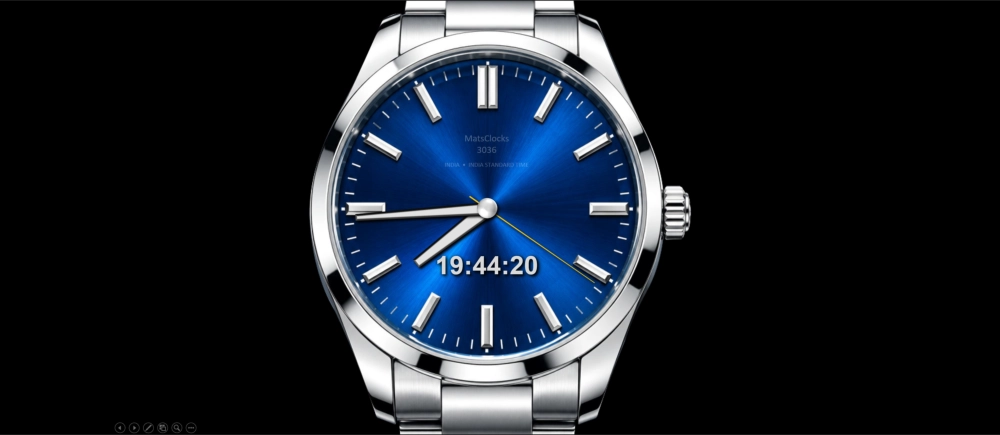
Free Download MatsClocks-3036 Time in India
The MatsClocks-3036 Time in India PowerPoint Presentation Clock displays the Local Time in India now. You don't have to be in India. Irrespective of which country you are running this PowerPoint Presentation, the clock will show the Local Time in India.
All MatsClocks are in Zip files which can be opened using WinZip or any common file compression program. These clocks are made in Microsoft PowerPoint software. If not installed in your device then please Download Microsoft_Office Software.
Time in India: India Standard Time, History, UTC, Time Zones and Live Clocks
Time is something we rarely stop to think about. We wake up when the alarm rings, go to work or school according to the clock, meet friends at an agreed hour, catch trains and flights at scheduled times, and go to bed when the day is over. Yet the system behind the clock on your wall or phone is surprisingly fascinating.
If you are searching for the time in India, you are looking for more than just a number on a clock. You are looking at a national system of time that connects cities, businesses, schools, transportation networks and people across one of the world's largest countries.
India has a particularly interesting approach to time. Despite its enormous east-to-west geographical span, the entire country officially follows one time zone: India Standard Time (IST).
Let's explore what Indian Standard Time means, where it came from, how it compares with time around the world, why India does not use daylight saving time, and how modern technology makes it possible to display the live time in India anywhere in the world.
What Is the Time in India Now?
The time in India follows India Standard Time, abbreviated as IST.
IST is 5 hours and 30 minutes ahead of Coordinated Universal Time (UTC). It is therefore written as UTC+5:30.
For example:
- 6:00 AM UTC = 11:30 AM in India
- 9:00 AM UTC = 2:30 PM in India
- 12:00 noon UTC = 5:30 PM in India
- 6:00 PM UTC = 11:30 PM in India
The important thing to remember is that India does not change its official clock according to the season. India remains at UTC+5:30 throughout the year.
That makes the time in India or India Standard Time relatively straightforward to calculate once you know the UTC time.
Time in India Has Only One Official Time Zone
One of the most interesting things about Indian time is that the entire country uses one official time zone.
Whether you are in New Delhi, Mumbai, Kolkata, Chennai, Bengaluru, Hyderabad, Ahmedabad, Jaipur or Kerala, the official clock shows IST.
This is remarkable when you consider India's geographical size.
The country stretches thousands of kilometres from west to east. The Sun therefore does not rise and set at exactly the same time everywhere.
A person in eastern India may see the sunrise significantly earlier than someone in western India. Nevertheless, both people's clocks show the same official time.
This is a deliberate national standard rather than an attempt to make sunrise and sunset occur at the same clock hour everywhere.
Why Is Indian Standard Time UTC+5:30?
The Earth rotates through 360 degrees approximately every 24 hours. This means that, as a broad approximation, every 15 degrees of longitude corresponds to one hour of time.
The reference point for the world's timekeeping system is UTC.
India lies roughly five and a half hours ahead of UTC geographically, which is why its standard time is UTC+5:30.
The half-hour offset makes India unusual compared with countries that use whole-hour offsets. However, India is not alone. Several countries and regions around the world use time zones that are offset from UTC by 30 or even 45 minutes.
The History of Time in India
The history of time in India is closely connected with the development of railways, telegraph systems, administration and modern communications.
Before standardized time in India became essential, local communities could naturally follow local solar time. The position of the Sun in the sky provided the most obvious way of determining the time of day.
But things became more complicated as transportation and communication improved.
Imagine a railway timetable in which every major city followed its own local solar time. A train travelling hundreds or thousands of kilometers would have to operate according to multiple local times.
Standardized time solved this problem.
During the British period, different cities and regions used different official times. Historical examples include Bombay Time and Calcutta Time. Eventually, the need for greater coordination encouraged the adoption of a national standard.
India Standard Time was established using a reference meridian corresponding to 82.5° east longitude.
This Indian Standard Meridian passes through the region around Mirzapur in Uttar Pradesh and corresponds closely to the UTC+5:30 offset used today.
Is There Daylight Saving Time in India?
No. India does not currently observe Daylight Saving Time.
This is one of the easiest aspects of Indian time to understand.
In countries that use daylight saving time, clocks may be moved forward during part of the year and moved back later. This can make international time-zone calculations surprisingly confusing.
India does not make these seasonal clock changes.
The official time remains:
IST = UTC+5:30
throughout the year.
So if you are arranging a meeting with someone in India, you need to consider whether your country changes its clocks for daylight saving time, but you do not need to worry about India's clock changing.
Why Doesn't India Have Multiple Time Zones?
This question comes up frequently because India is geographically wide.
Countries such as the United States, Russia, Canada and Australia use multiple time zones because of their enormous east-west distances.
India could theoretically benefit from multiple time zones too. The eastern states experience sunrise and sunset considerably earlier by the clock than western parts of the country.
In fact, if the Sunrise in Mumbai in India is at 6:30 am IST, then in the Andaman Islands which is located over 2300 kilometers to its East, the sunrise would be at 3:30 am, and the Sun would set at 3:30 pm or earlier, which is very funny.
There have been proposals and discussions about creating separate time zones, particularly to better align working hours with daylight in India's northeastern regions.
However, the time in India continues to use one official time zone.
There are practical reasons for this. A single time zone makes nationwide schedules easier to coordinate and avoids potential confusion involving transportation, communications, government administration and business.
Time in India and Sunrise
There is an important distinction between clock time and solar time.
Clock time is the standardized time displayed by your watch or phone.
Solar time is related to the actual position of the Sun.
Because India covers a large geographical area, the Sun reaches its highest point at different clock times in different locations.
This means that two people can both have clocks showing 7:00 AM while experiencing noticeably different amounts of daylight.
It is one of the fascinating consequences of using a single national time zone across a large country.
Time in India Compared With Other Countries
The time difference between India and another country depends on the other country's time zone and, in some cases, daylight saving time.
For example, the time in India is:
- Ahead of the United Kingdom for much of the year
- Ahead of Central European Time
- Ahead of the United States
- Ahead of Japan by 3 hours and 30 minutes
- Behind Australia in several Australian time zones
However, international time differences can change when another country begins or ends daylight saving time.
This is why simply memorizing one time difference is not always enough when planning international meetings.
A world clock that automatically accounts for time-zone rules can be much more convenient.
Time in India for International Business
India has become a major destination for international business, technology, outsourcing, education and professional services.
Companies around the world communicate every day with colleagues, customers and partners in India.
This makes knowing the time in India extremely useful.
Suppose a company in London wants to arrange a video conference with a team in Bengaluru. A company in New York wants to speak with its Indian development team. A teacher in Europe wants to conduct an online class for students in India.
In each situation, getting the time right matters.
A meeting scheduled at an inconvenient hour can be frustrating. A meeting scheduled for the wrong time can be missed completely.
For international teams, displaying Indian time alongside local time can make coordination much easier.
Time in India for Travelers
Travellers also benefit from understanding IST or India Standard Time.
If you are flying to India from another country, your body may initially be operating according to your home time zone. Your phone may automatically adjust when you arrive, but understanding the time difference can still help you prepare.
It is useful when planning:
- Flight departures and arrivals
- Hotel check-in
- Train journeys
- Airport transfers
- Tours and sightseeing
- Business meetings
- Restaurant reservations
- Calls home
Knowing the local time in India helps you organize your day rather than relying entirely on guesswork.
Digital Clocks and India Standard Time
The way people check time has changed dramatically.
Traditional clocks once dominated homes, schools and offices. Today, smartphones and computers can display highly accurate digital time automatically.
A digital clock showing India Standard Time can be particularly useful for someone living outside India but regularly communicating with people in the country.
Instead of mentally converting your local time, you can simply look at a dedicated Indian clock, like the MatsClocks 3036 that shows you the time in India now, irrespective of where in the world you run this PowerPoint Presentation Clock.
An Analog Clock Showing Time in India
There is also something timeless about an analog clock.
Watching the hour, minute and second hands move around a traditional clock face gives you an immediate visual understanding of the passage of time.
A modern digital display tells you precisely what the time is. An analog clock gives you a feeling for where you are within the hour.
Combining both can provide the best of both worlds.
MatsClocks 3036 is a PowerPoint presentation that contains an analog clock with moving hour, minute and second hands together with a digital display showing the exact time in India.
A Live PowerPoint Clock for Time in India
Imagine opening a PowerPoint presentation anywhere in the world and seeing a clock that automatically displays the current time in India. That is what MatsClocks 3036 is designed to do.
You could be presenting from London, New York, Singapore, Tokyo or anywhere else. The presentation could still display Indian Standard Time rather than the local time of the computer.
This is possible by creating a PowerPoint macro-enabled presentation using VBA.
A properly designed PowerPoint clock can:
- Display Indian Standard Time
- Run automatically during Slide Show mode
- Show moving hour, minute and second hands
- Display a digital Indian time readout
- Continue showing IST or India Standard Time, regardless of where the presentation is being run
- Use the computer's UTC time as its reference
- Avoid depending on the computer's local time zone
This can be especially useful for presentations involving Indian offices, international teams, online teaching, webinars and global business meetings.
Why Use UTC as the Reference?
A world clock should ideally avoid depending on the computer's local clock setting.
If a presentation simply reads the computer's local time, a person running the presentation in London might see London time, while someone running exactly the same presentation in New York would see New York time.
That is not useful when the purpose of the clock is to show Indian time.
A better approach is to obtain UTC and then apply India's fixed UTC+5:30 offset.
Conceptually:
Indian Time = UTC + 5 hours 30 minutes
This allows a clock to display IST regardless of where the computer running the presentation is located.
The Value of a World Clock
The modern world is increasingly connected.
A business may have employees in India, customers in Europe and partners in North America. A teacher may have students scattered across different countries. Families may live on opposite sides of the world.
Time zones can become a daily source of confusion.
A world clock solves a surprisingly simple but important problem: it puts different locations' times where you can see them.
When the time in India is displayed clearly next to another country's local time, scheduling becomes much easier.
Time Is More Than Numbers
There is something deeper about time than simply knowing whether it is 10:15 or 10:16.
Time organizes our lives.
It tells us when a school day begins, when an aircraft departs, when an office opens, when a television program starts and when friends are expected to meet.
For a country as large and diverse as India, a standardized national time provides a common framework.
Millions of people may live thousands of kilometers apart, but their clocks share the same official standard.
Frequently Asked Questions About Time in India
What time zone does India use?
India uses India Standard Time (IST), which is UTC+5:30.
Is the time the same throughout India?
Yes. India officially uses one time zone, so the same official clock time applies across the country.
Does India change its clocks for daylight saving time?
No. India does not currently observe daylight saving time.
Is IST or India Standard Time always UTC+5:30?
Yes. India's standard time remains UTC+5:30 throughout the year.
Why does India have a half-hour time difference?
India's standard meridian at 82.5° east longitude corresponds to five and a half hours ahead of UTC, producing the UTC+5:30 offset.
Can I display Indian time outside India?
Yes. Smartphones, computers, world clocks and properly designed software can display Indian Standard Time regardless of your physical location.
Can PowerPoint display the time in India?
Yes. A macro-enabled PowerPoint presentation can be programmed to display live Indian Standard Time, including analog hour, minute and second hands and a digital time display. MatsClocks 3036 shows you the time in India now using a digital clock display as well as in an analog clock with Hours, Minutes and Seconds needles, in a PowerPoint Presentation Slide.
Final Words About Time in India
The time in India is simple on the surface but fascinating when you look beneath it.
India stretches across a vast geographical area, yet the entire nation officially follows one clock: India Standard Time, UTC+5:30.
There is no seasonal clock change, no daylight saving adjustment and no need to remember different official times for different Indian cities.
For everyday life, IST or the India Standard Time provides a common reference for more than a billion people. For international businesses and travellers, understanding Indian time makes communication and planning easier. And with modern technology, displaying the live time in India is now possible virtually anywhere in the world.
Whether you are checking the time on a smartphone, looking at a traditional wall clock, using a world clock or displaying a live clock inside a PowerPoint presentation Slide like MatsClocks 3036, the purpose is ultimately the same:
to know exactly where you are in the day — and to stay connected with the people and places that matter.
Free Download MatsClocks-3036 Time in India
If you do not have PowerPoint software installed in your device then
please get
Microsoft_Office Software with essential Office
software apps like Word, PowerPoint, Excel, and One Note etc. Update
it if you already have Microsoft Office installed in your devices.